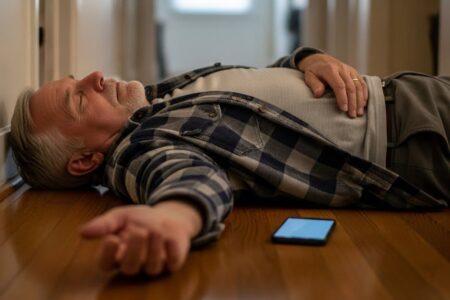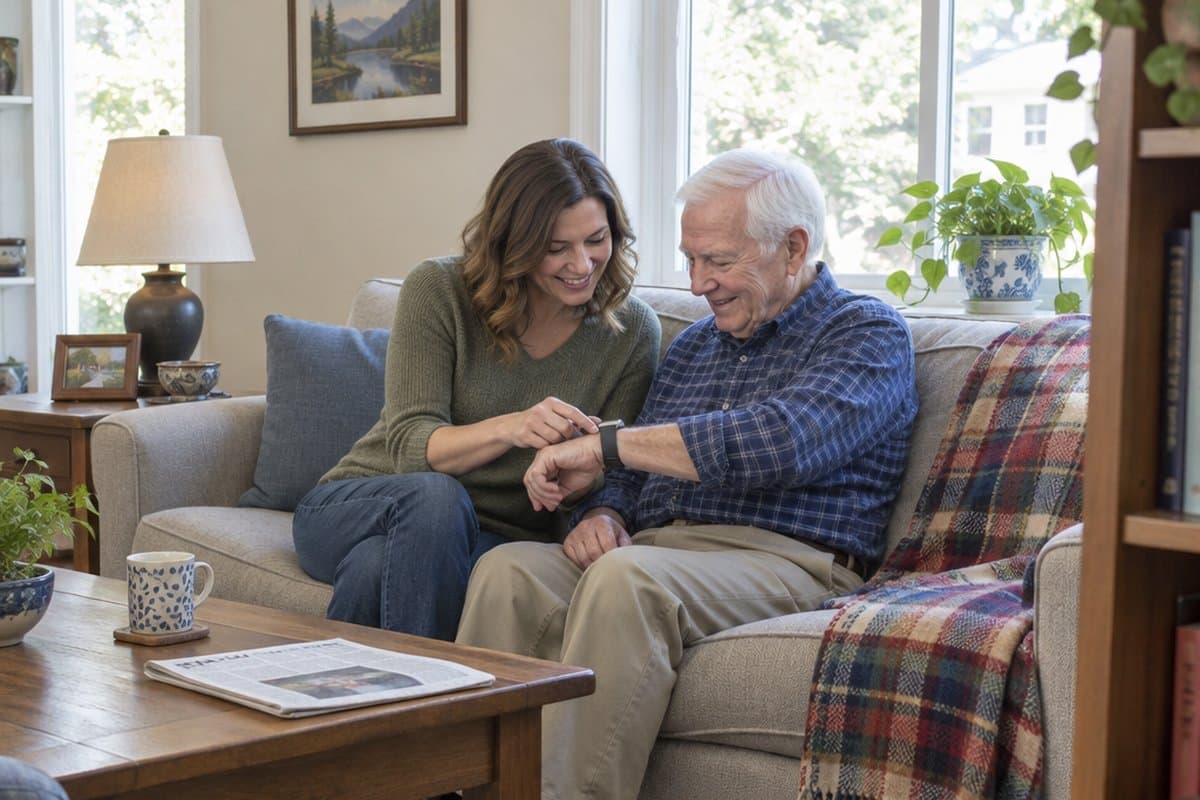
If you want the short list, these are my top wrist worn fall detector picks for high fall risk seniors, and you’ll find the details on each one further down.


If someone you love has fallen, or you worry they might, you want a way to know quickly. More than one in four older adults fall each year, according to the CDC estimates.
Many never mention it, so the fall and its consequences go unchecked.
This article covers wrist worn fall detectors, and how monitoring your loved one can work for those at high risk.
How Do Wrist Worn Fall Detectors Work?
All wrist worn fall detectors use several sensors and a lot of data analysis to recognize a fall is taking place.
Typically, a fall detector watch will combine data from an accelerometer and gyroscope to determine the arm’s position, its trajectory, and the impact acceleration occasioned by a fall to determine if a fall has occurred.
After sensing a fall has occurred, the wristwatch or wristband will wait for a few seconds before activating a fall alarm and notification, which can be sent to the emergency services or a loved one.
The short wait is designed to weed out false readings before sending the message to emergency services or monitoring call centers.
If the watch senses regular movement, the fall detected might have been wrong, or it might have been a small fall not warranting a visit by emergency services.
What Are the Pros of Wrist Worn Fall Detectors?
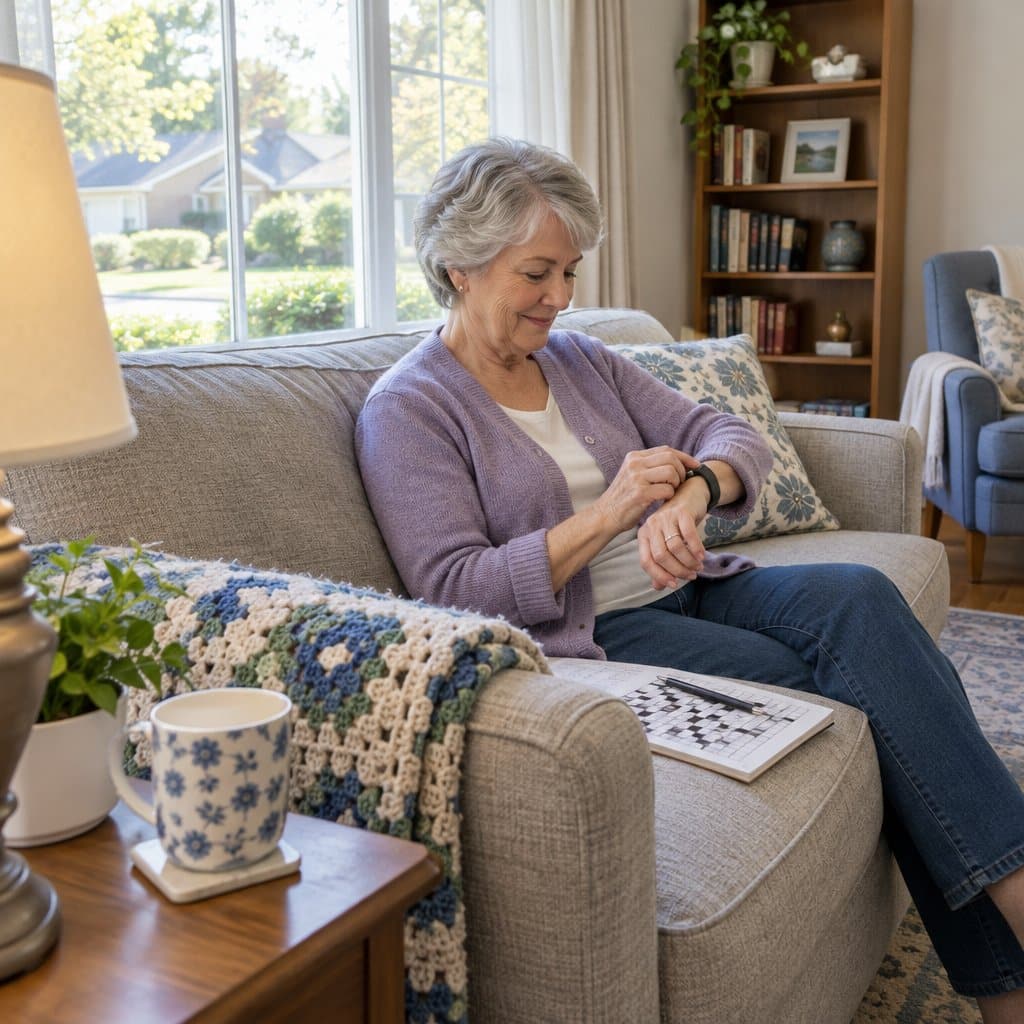
- They Are Discreet – Wrist worn fall detectors, especially modern models, are some of the most discrete fall detectors you can purchase for a senior loved one. Their form factor gives them a similar appearance to a regular smartwatch. In fact, some models include fall monitoring as an added feature to other smartwatch features. As such, you can purchase a fall monitoring watch or wristband that incorporates a large variety of features such as heart monitoring into one device. This bodes well for our seniors who want to avoid the stigmatization of wearing falling monitors while still needing a system for monitoring falls.
- Lightweight And Slim Design – The improvements in the gyroscope and accelerometer technology have allowed the miniaturization of components with performance improvements. Better and more accurate fall detectors can easily fit in a wrist worn device while being small in size and lightweight in their manufacture. These design elements make it easier for seniors to wear the device on a long-term basis.
- Comfortable To Wear – Most wrist worn fall detectors are ergonomically designed to fit around the wrist. They are contoured to fit around snuggly without causing blood flow issues to the hand.
- Easy To Wear And Use – Modern wrist worn fall detectors are intuitive and easy to use. Wearing them is similar to wearing a typical wristwatch. On the other hand, intuitive software in modern fall detectors is designed with ease of use.
What Are the Cons of Wrist Worn Fall Detectors?
- Some Have Poor Location Data – While wrist worn fall detection devices provide the user’s location, i.e., your address, they may not communicate the user’s precise location in a building. This means emergency services may find it hard to locate the user fast enough.
- Some Are Limited In Capabilities – Many wrist worn fall detection systems have limited capabilities. In some cases, the device is only used to detect falls and nothing else. Such devices waste the real estate on the wrist rather than performing a myriad of functions.

How Do Wrist Models Compare to Medical Alert Pendants?
In terms of accuracy, wrist detectors feature advanced sensors, better computing capabilities, and better software. In many regards, the modern wrist models are more accurate. They perform better in discerning between false alerts and genuine falls.
However, while some areas have seen advancements, other regions are experiencing retardation, especially in wrist worn systems. For instance, some wrist models do not include a two-way talk system, a feature that is standard in many pendant models.
On the aesthetic front, wrist worn fall detectors easily blend in with other accessories a person wears. In some cases, the fall detection feature comes as a feature in smartwatches.
For instance, the Apple Watches starting from Series 4 have a fall detection feature. As such, a senior might use these watches as a regular smartwatch while the fall detection feature runs in the background.
What Are the Best Wrist Worn Fall Detectors
Based on all the factors above and my own hours and hours of research, here are the best wrist worn fall notification devices I was able to find.
Lively Mobile2 Medical Alert System
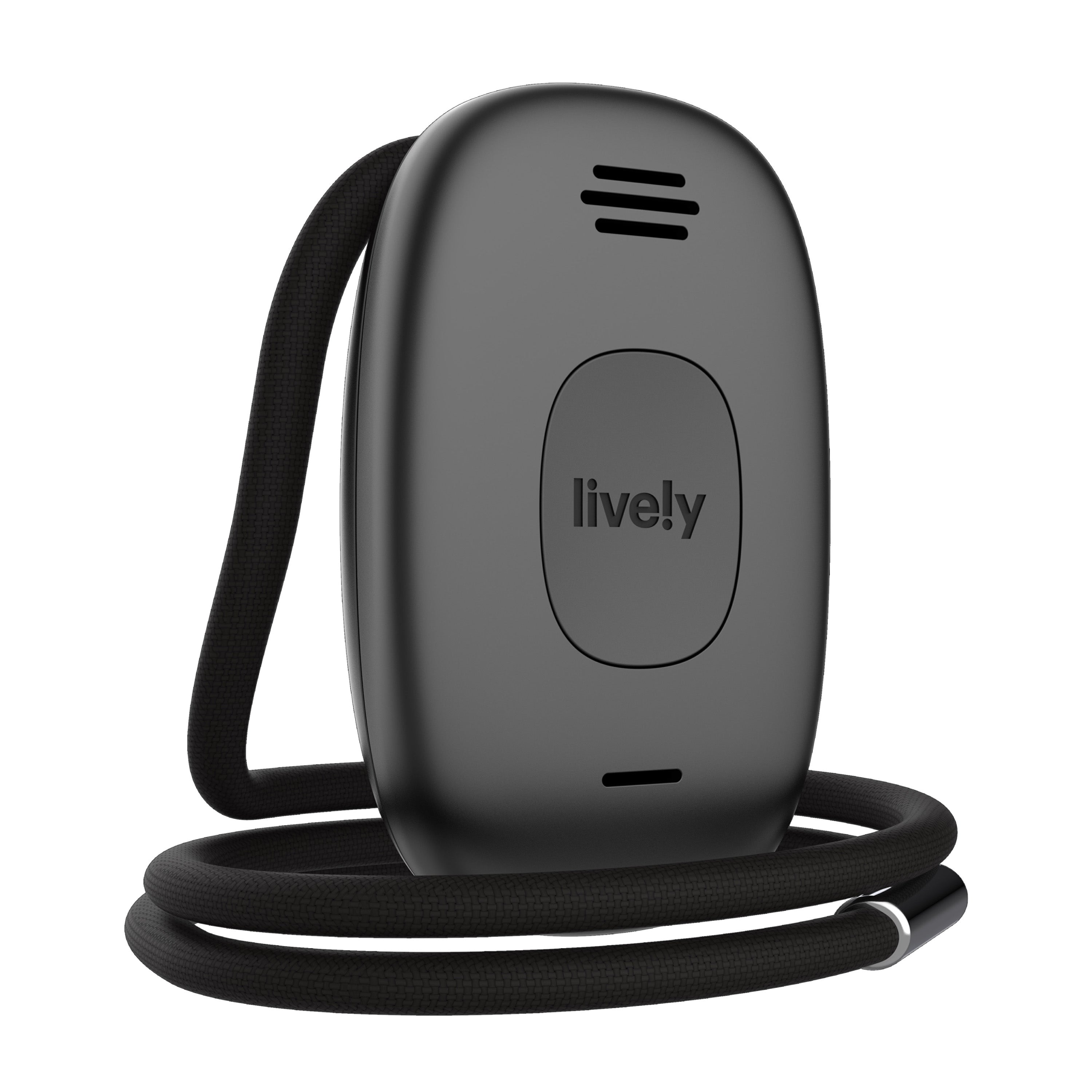
The Lively Mobile2 All-in-One is a medical alert device you can take anywhere. It uses GPS to track your location, and it has a long-lasting battery.
Press the button and you reach a certified Urgent Response agent. The agent confirms where you are, figures out what is going on, and gets you help.
Fall detection is available as an add-on service. With it, you are connected to an agent when a fall is detected, even if you are unable to press the button yourself.
That matters most for someone at high risk of falling, since a fall is exactly when pressing a button may not be possible.
A few things to know before you buy. Fall detection is not part of the basic service, so you need to add it. You choose your Lively service and data plan when you activate the device, and it cannot be used with other carriers.
It is also not a fitness tracker, so if you want step counts and health data, this is not the right fit. It is FSA and HSA eligible, which may help if you have one of those accounts.
NOMO Smart Care Medical Alert System

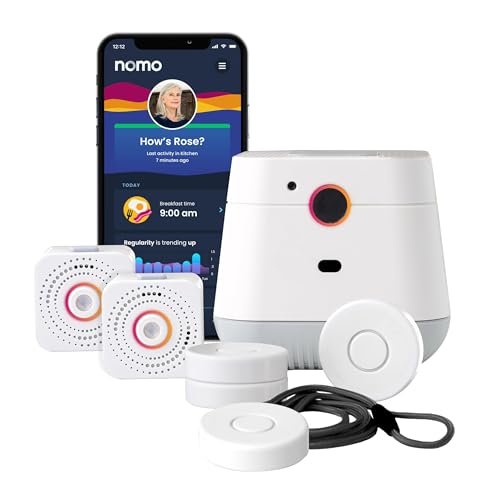
The NOMO Smart Care Medical Alert System is a fall detection setup built around your home WiFi. It does not use cameras, so there is no lens pointed at anyone in the house.
The user wears a tag that detects falls. When one happens, it sends a real-time alert to a Care Circle, which is the family members or friends you choose to be notified.
There is also a Hub with two-way voice. A caregiver can speak straight to the person through the Hub, without anyone having to pick up a phone.
Setup is plug-and-play. No technician and no wiring.
Now the downsides. The system depends entirely on WiFi, so if the home internet goes down, the alerts stop. It also only works at home, so it is not the right pick for someone who wants protection while out walking or running errands.
The 24/7 professional emergency response needs a monthly subscription of 19.99 after the 60-day trial. If your family plans to be the only responders, ask yourself whether that is the help you want.
I think it suits a person who lives at home and has family close enough to act on an alert. Before buying, make sure the WiFi reaches every room where a fall could happen.
Medical Guardian Mobile Medical Alert Device
The Medical Guardian MGMini is a medical alert device you wear as a necklace or clip to a belt. Two lanyards and a belt clip come with it, so you can pick whichever is comfortable.
If you need help, you press the emergency button and talk through the two-way speaker. You reach Medical Guardian’s 24/7 monitoring team, and a trained, U.S. based operator contacts EMS, family, or friends, depending on what you need.
Family can also see hourly location updates and step counts on the online portal or app. That gives them a little peace of mind without constant phone calls.
One thing to know before you buy: the device does nothing until the monitoring service is activated, online or by phone. The service is a paid subscription, with no long-term contract, and you can cancel anytime.
It is also not a smartwatch. It has no clock, weather, or text messages, so if you want a watch that does those things, look elsewhere. And since the emergency button is pressed by hand, it works best for someone who can reach it and press it after a fall.
Apple Watch Series 7 Smartwatch
From Series 4, Apple Watches come with a fall detection system.
In addition to the array of apps and features, including fitness tracking, weather notices, heart rate tracking, and alters and reminders, you can use an Apple Watch to detect falls.
The fall detection feature is automatically activated for users above the age of 65 and older.
The sleek design uses an advanced gyroscope and accelerometer to detect falls.
If a fall is detected, the watch displays a notification, giving users a chance to cancel fall detections. If users do not cancel the alert, emergency services are automatically summoned.
ADT Medical Alert Plus System
ADT Medical Alert Plus is an in-home emergency response system with automatic fall detection. If a fall is detected, or you press the help button, the system connects you to ADT’s monitoring center, which is staffed 24 hours a day by U.S. based agents.
It runs on a 4G cellular connection, so it does not depend on a landline. The range extends up to 600 feet, which covers the house and usually the yard too.
It also watches the temperature inside the home. If it climbs above 105° F or drops below 35° F, an alert goes to ADT. That is a useful safeguard if the heat or air conditioning fails while no one is around.
There are trade-offs. Using it requires a monthly monitoring agreement, and the device has to be activated by phone before it works. There are no long-term contracts, but it is an ongoing service, not a one-time purchase.
It is built around the home and the area close to it. If you want protection while you are out running errands or traveling, this is not the right fit.

Summary and Final Recommendations
While wrist worn fall detectors are not all in the fall detection systems, they are a massive improvement to the traditional fall detection necklaces.
Many of the modern fall detection devices are proper health and fitness tracking devices. These technological devices for detecting falls will notify the caregivers and emergency services when the user, as well as track the overall health of the user.
With their discrete form factor, exceptional comfort, and stunning performance, seniors can wear the devices all day long.
Whether you are a caregiver or a senior looking for a discrete fall detection system, pick your detection system from our list of the best wrist worn fall detectors.