
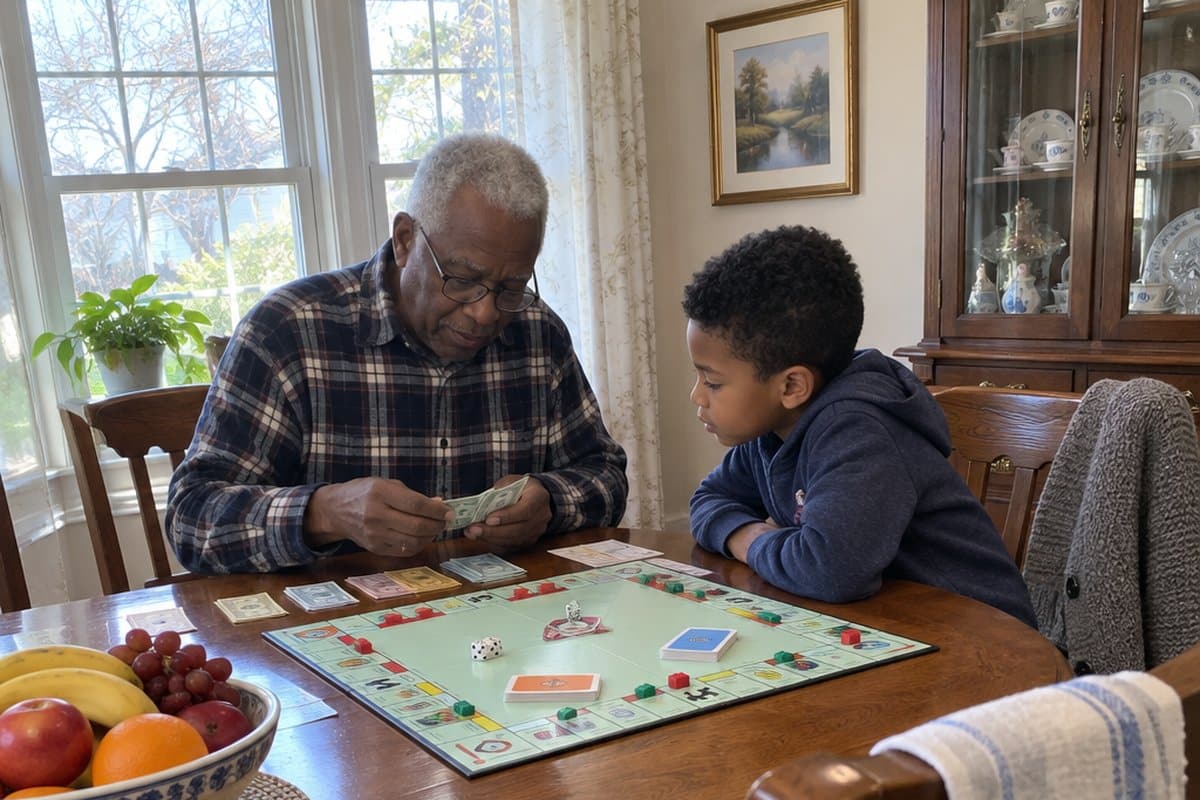
If you want the short list, these are my top board game picks for seniors, and you’ll find the details on each one further down.

A good board game passes the time and gives the mind a little exercise too. The trick is finding one that fits the person who will be playing it.
The games below are grouped by type. Further down you will also find large print options for low vision, games you can play alone, games that build focus, and games for memory loss.
- Seniors with vision problems will benefit from games that have larger print which is easier to read.
- Games with larger pieces are easier for seniors with arthritis or motor dysfunctions to handle and use.
- Quick games that last less than 30 minutes are ideal for seniors who have Alzheimer’s disease, dementia, or other cognitive degenerative conditions.
Below are some ideas for board games (and games in general) that are both entertaining and good for the mind:
Strategy Games
Ticket to Ride Board Game

Ticket to Ride Rails & Sails takes the classic train game around the world. You collect cards to claim railway routes and sea routes, using both trains and ships.
The board is double-sided. One side shows the world map, and the other shows the Great Lakes of North America. If you like picking out cities and places you have visited or always wanted to see, that part is a pleasure.
The rules are described as simple and quick to learn, so a first game does not have to start with a long lecture. It is made for 2 to 5 players, ages 10 and up, which makes it easy to bring in a grandchild or two.
The trade-off is time. A game runs 90 to 120 minutes, which is a long sitting. If you or your partner lose interest after half an hour, or find it hard to keep track of a plan for that long, a shorter game will suit better.
It also has more to keep in mind than a basic card game, since you are juggling two kinds of cards and two kinds of routes. It suits people who enjoy planning ahead and have a free afternoon or evening.
Smart Zone Hive Strategy Game

Hive is unique in that it combines different types of games and allows you to create the board as you play. The object of the game is to surround your opponent’s queen.
The game is simple and straightforward but the puzzling nature of the game is great for the brain. Beware, this game is very addictive and will keep seniors occupied for hours on end.
Word and Letter Games
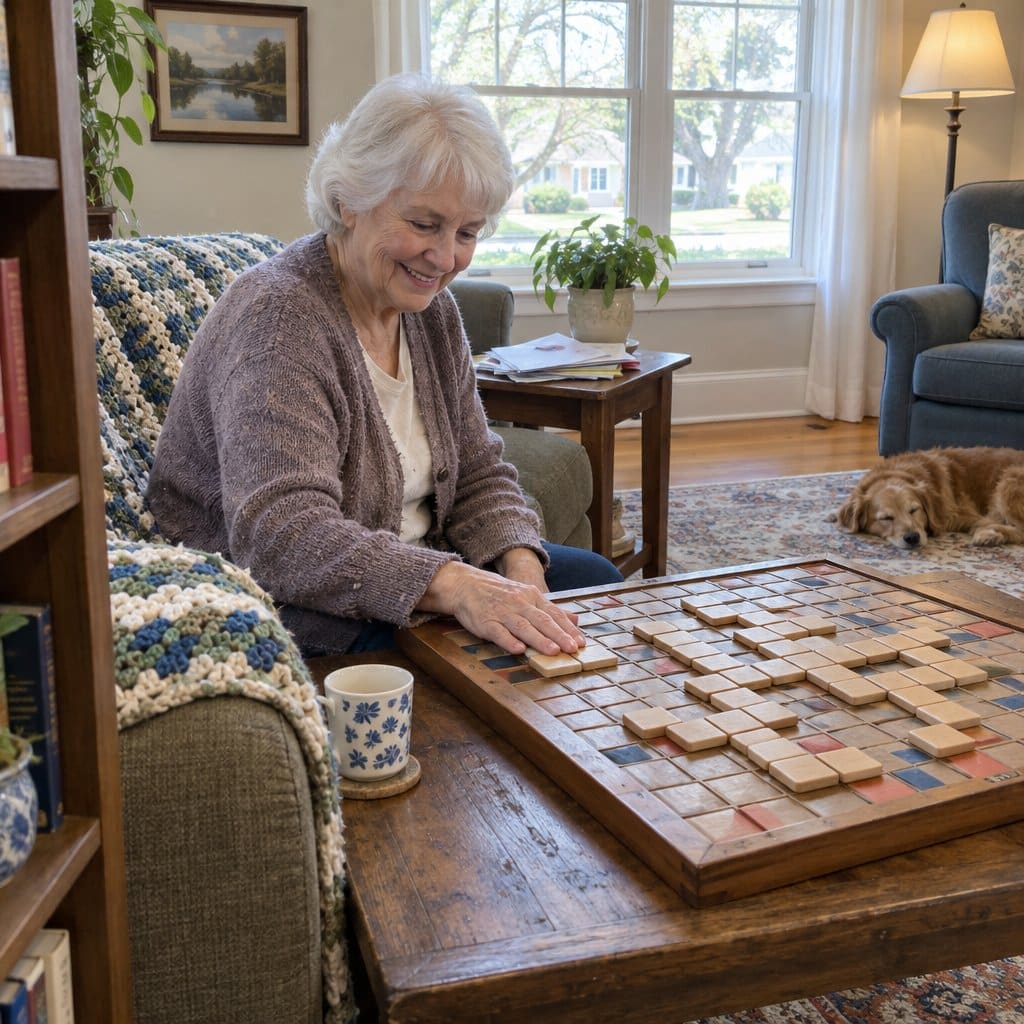
Big Letter Bananagrams Word Game

Bananagrams is similar to Scrabble where you pick tiles and make as many words as possible horizontally and vertically – except there is no complicated scoring system. The person who gets rid of all their tiles first shouts “Bananas” and is the winner.
A Big Letter version of the game is available for people with low vision. Word games give the mind a good workout. The bonus is that you can play this game alone or with 1 or more people.
Low Vision Scrabble Tiles

If your senior prefers the additional challenge of scoring and playing the word game on an actual board, Scrabble is ideal. Large Scrabble tiles are also available.
Quick Puzzle and Matching Games
MindWare Qwirkle Strategy Game

Qwirkle is a puzzle game with a good dash of strategy and involves matching tiles of the same color or shape to beat one or more opponents. This is a quick game and takes about 30 minutes to complete on average.
Puzzle games give the brain a good workout. Qwirkle also asks you to solve problems and make decisions as you play.
Connect 4 Strategy Board Game

Connect 4 is a simple strategy game. You take turns dropping colored discs into an upright tray, and the first player to get four of their color in a row wins. The row can run up, across, or diagonally.
This version, the Hasbro Gaming Connect 4 Strategy Board Game, adds a blue Blocker Disc. You can use it to block your opponent, and it lifts the discs higher. That gives you a few more moves to think about than the plain game.
Strategy games like this give the mind a workout, and simple ones like this can be easy to enjoy for someone living with dementia or Alzheimer’s disease. The rules take a minute to explain, so it is easy to sit down and play with a grandchild or a friend.
One thing to know: it is a two-player game, so it will not work for a group. It is also labeled for ages 6 and up, so the box is aimed at children. If you want a game with more depth, this one may feel light after a few rounds.
Family Classics
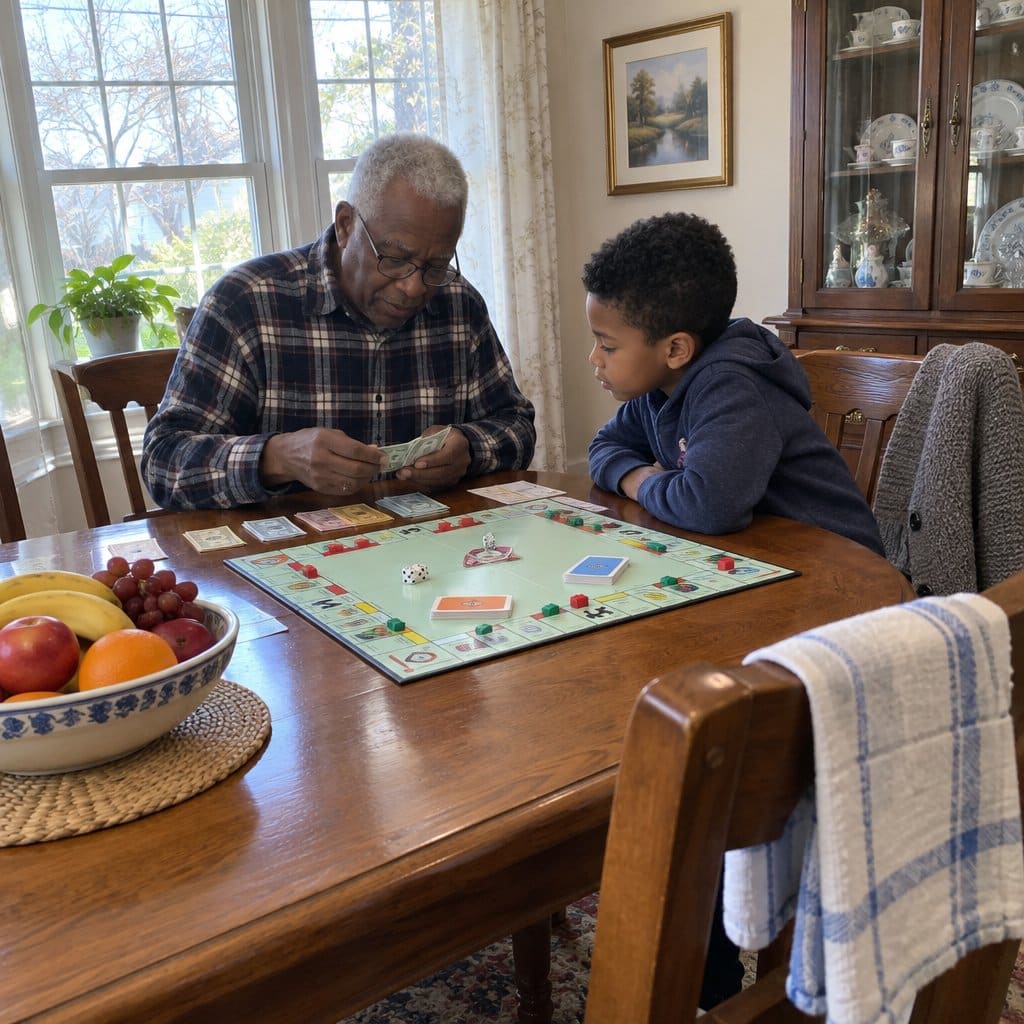
Monopoly Board Game

Monopoly is one of the oldest and favorite board games in existence. The goal of the game is to monopolize the board by buying properties and building houses and hotels until your opponents go broke.
The game can be a little complicated and the pieces a touch fiddly. The gameplay should last around an hour but can take much longer. The game is great for seniors who want to practice their problem-solving and decision-making skills.
Other versions from different parts of the world or the U.S. are also available. Seniors might enjoy playing the game more with street names that they recognize.
Cranium 3-in-1 Game Board

Cranium is basically the upgraded version of charades and will have you humming, drawing and even sculpting to solve puzzles.
Puzzle-solving games give the brain a good workout and get you using memory and recall. Cranium also offers plenty of fun.
Trivia and History Games
Loquacious Trivia for Everyone

Trivia for Everyone from Loquacious Games is a card-based trivia game for two or more players. It comes with 190 cards and 1,520 questions, so you can play many nights before a question repeats.
The questions mix general knowledge, like how many hearts an octopus has, with lighter ones, like who lives in a pineapple under the sea. That mix helps if someone at the table groans at the word “trivia.”
It also has two difficulty levels, so you can play the easier one when the group is mixed or when you just want to chat and laugh. The questions are meant to suit adults, teens and families, which makes it a good pick when grandchildren come over.
One thing to know: the game is rated for ages 14 and up, and some of the pop culture questions may lean toward younger players. If your group likes history and classic quiz questions only, a few cards may get a shrug. It is also a card game with no board, so there is no pie to fill and no race to the finish. That keeps it simple, but it is a different feel from the old Trivial Pursuit.
Buffalo Games Chronology Trivia Game
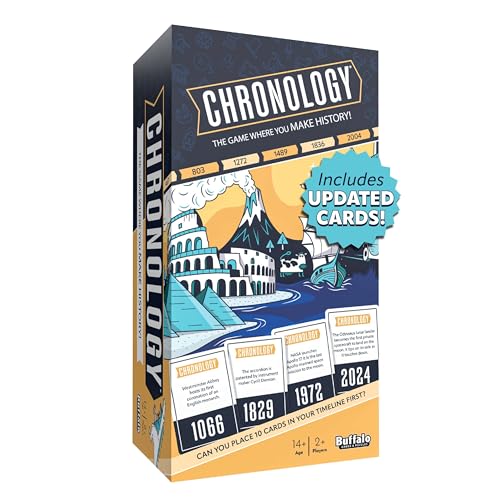
The goal of Chronology is to arrange 10 cards in chronological order as they occurred in history.
A senior’s knowledge of history and having been there when some of the events occurred gives them an advantage in this game. It is a great confidence booster and works the brain and memory while playing.
Unfortunately, the game is not available as a large print game for seniors with vision problems. However, the dates and other information are already in a larger font which should be easy for seniors with vision problems to read.
Timeline Card Game

Timeline Card Game (2025 Refresh) is a history guessing game. Each card shows an event, invention, or discovery. You try to place your card in the right spot among the cards already on the table, from earliest to latest.
It comes with 96 illustrated cards and a rule booklet, and the rules are simple enough to learn in a few minutes. A game runs about 15 minutes, so it works for an afternoon visit without taking over the whole day.
This one suits people who like trivia and enjoy swapping stories about when things happened. Many older adults will remember some of these events firsthand, which tends to get the table talking. No history degree is required, and a wrong guess usually earns a laugh.
One trade-off: it depends on remembering or guessing dates, so someone who gets frustrated when they miss an answer may not enjoy it. The listing also gives different player counts (2 to 6 in the title, 2 to 8 in the description), so if you are buying for a bigger group, check the box first.
Dice Games
Hasbro Yahtzee Dice Game
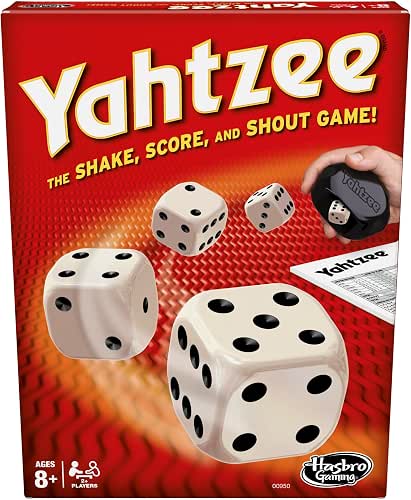
Yahtzee is a game of chance combined with strategy. This is the ideal dicing game for seniors and is not complicated nor does it take too long to play.
It is recommended to opt for a box set that includes larger dice or simply swap the dice out for bigger ones that are easier to see.
Farkle Dice Game

Farkle is a dice game where you roll six dice and try to collect scoring combinations. The more you roll, the more you score. The catch is that if you keep rolling and come up empty, you lose the points you built up that turn. That is a “Farkle.”
It suits anyone who wants a quick, easy-to-learn game with a little suspense. It plays with two or more people, so it works for a pair at the kitchen table or a full family night. The set comes with six dice, a dice cup with a lid, and the rules.
The box is described as easy to travel with, so it is a good one to bring along on a visit to relatives or a day trip.
The trade-off: it leans heavily on luck. If you like games where careful planning wins, you may find it light. It also needs a flat surface and a steady enough hand to roll, which could be tricky for someone with significant arthritis.
Mahjong and Dominoes
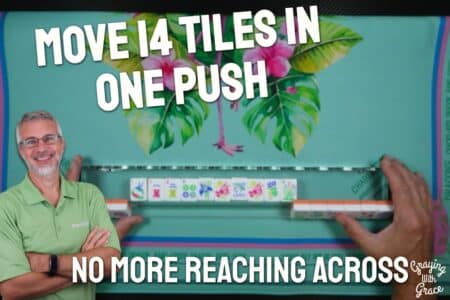
Averill Monet's Garden American Mahjong Set
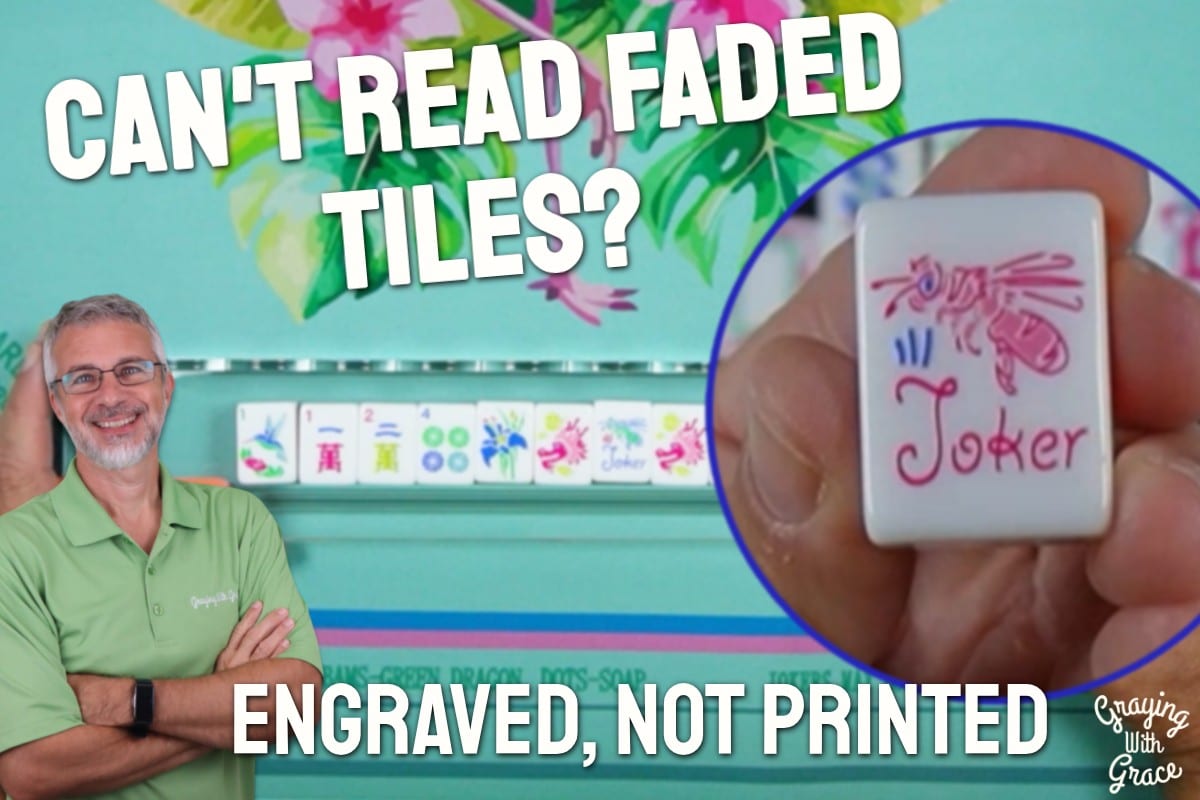

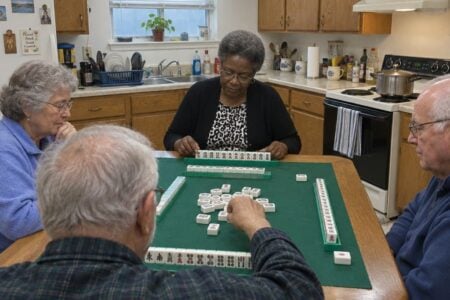
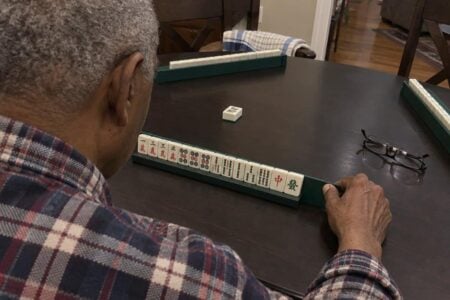
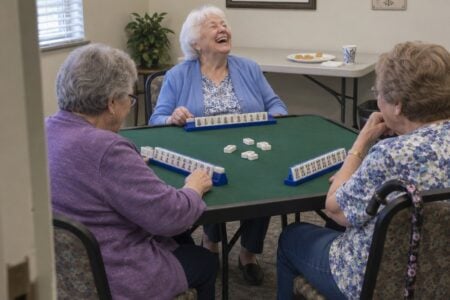
Mahjong is an ancient Chinese game that basically consists of matching the same tiles and beating an opponent. However, the game is actually all about strategy.
It can also be played alone and large versions of the game tiles are available for visually impaired seniors. Larger tiles are also easier to handle for seniors who have arthritis or problems with fine motor skills and coordination.
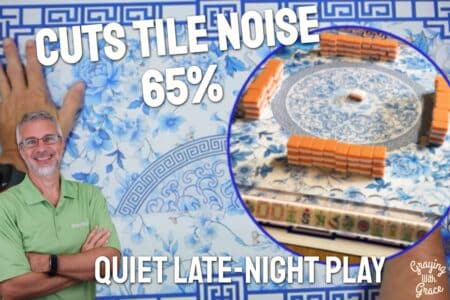
Monet’s Garden from Averill Mahjong is the set I showed on camera. It is a full 160-tile American set, and the numbers and characters are engraved, so they will not rub off the way they do on an older set.
The tiles come in a light zippered pouch, which makes them easy to carry to a game. The pouch will not protect them from a hard drop, though, and you may need to buy the league card and racks separately.
Queensell Loomino Curved Mexican Train Dominoes


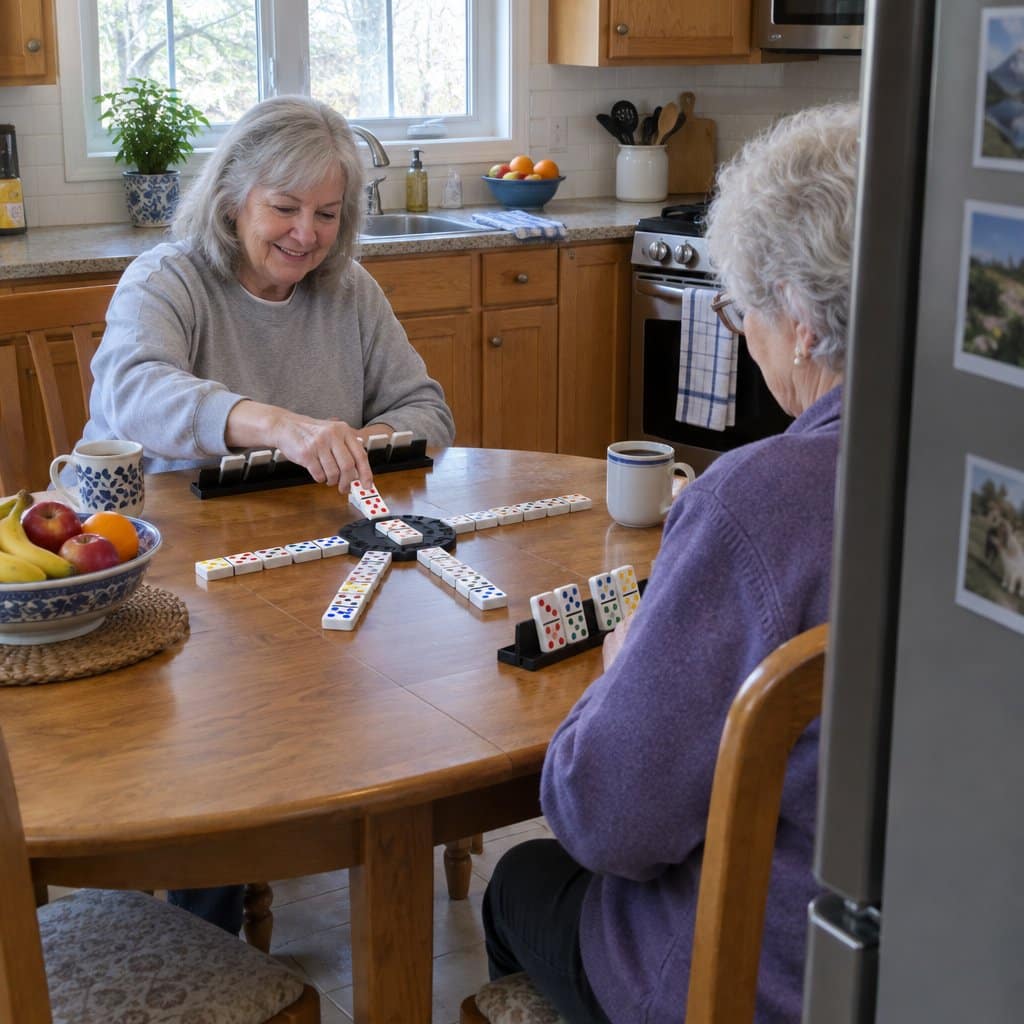
Dominoes is another one of those games that never seem to go out of fashion. The easy matching game also includes loads of strategies that will work that brain.
The two-player or more-player game can become quite competitive as you try to beat each other. Larger dominoes are available to suit visually challenged seniors and to ensure that the tiles are easier to handle.
Queensell’s Loomino Mexican Train set is the one I showed on camera, and it has a twist: the tiles are curved. Instead of a straight line, you build arcs and circles across the table.
It is a complete Double 12 set, with the hub, the trains and a case. The tiles are chunky and the dots are color-coded, which makes them easy to pick up and easy to read across the table.
The trade-off is table space, since curved tiles spread out more than straight ones. It also takes a game or two to get used to building in curves.
Large Print and Oversized Games for Low Vision
Cataracts, glaucoma and low vision can make a favorite game hard to read. That is no reason to stop playing, because many popular games now come in bigger, easier-to-read versions.
Mexican train dominoes is a good place to start. One version uses large, bright numbers on a white background, so there are no small dots to count. The tiles are oversized and easier to handle, and the game works for several generations at the table.
Standard Scrabble tiles are dark print on brown wood, which is hard to read. Large print tiles on a white background are much better. If your loved one already has a board, you can buy the tiles on their own. A giant Scrabble set has a board 50% larger, with slots that hold the tiles in place and a turntable. Because the tiles stay put, it also helps anyone with tremors.
Rummikub is a rummy-style game played with tiles instead of cards. The large print version has bigger, brighter writing, and bright green replaces the orange set for better contrast. That makes it easier to see your own tiles and the ones other players put down.
For card games like solitaire, Canasta, Bridge and rummy, large print cards have bigger letters and suit symbols. Uno comes in a giant version, with cards about 7-1/2 inches wide by 10-1/2 inches tall, nearly the size of a sheet of paper. Kids enjoy those too.
Checkers and chess come in jumbo sizes as well. A big checkers set lets players see the board and handle the pieces more easily, and the large pieces are less of a swallowing worry around small children, though you should still keep an eye on little ones. With chess, the real trouble is that tall pieces look alike when eyesight is poor. A large set with detailed pieces helps you tell the king from the queen.
One thing to weigh: oversized sets take up more table space, so measure before you buy.
Homwom Mexican Train Dominoes

Mexican Train is a domino game where each player builds a “train” of tiles from a center hub, and it works well for a group around a table. This Homwom set is a Double 12 version with 91 tiles, nine small colorful trains, a scoreboard, an octagon-shaped hub, an instruction booklet and an aluminum case.
The tiles are colored dot dominoes made from a durable, stone-like material, and they stand up without tipping over easily if the table gets bumped. The colors are bright, which makes the tiles easy to check at a glance. The case keeps everything together, and it makes the set easy to bring to a family gathering or a friend’s house.
One trade-off: this version uses dots, not numerals, so you will be counting pips on every tile. Double 12 is also a bigger set than the usual Double 9, so setup and a full game take a bit longer. It suits a group that enjoys a long afternoon at the table more than a quick round.
WS Game Scrabble Giant Deluxe

This is the classic word game in a giant version. The board measures 23.5 x 23.5 inches, which the maker says is more than twice the playing surface of a standard set. It has 100 oversized wooden tiles, and each one is 1.25 x 1.125 inches, so the letters are easy to read and easy to pick up.
The board sits on a turntable that spins a full 360 degrees. Instead of leaning across the table or trading seats, you turn the board toward whoever is playing. A raised grid holds the tiles in place while it turns. It plays 2 to 4 people.
The trade-off is size and weight. The frame weighs over 8 pounds and the board takes up a good part of a coffee table, so you need room for it and a place to put it away. If you have trouble lifting or carrying things, plan on leaving it set up or ask someone to move it for you.
Pressman Rummikub Large Numbers Edition
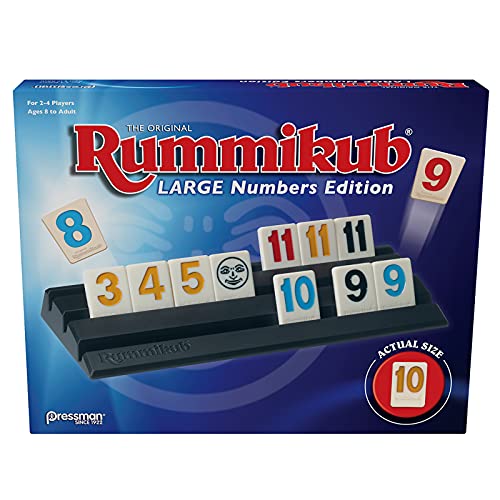
Rummikub is a tile game where you build runs and sets of numbers, and the goal is to play all of your tiles. This Large Numbers Edition has bright, over-sized numbers, so the tiles are easy to read.
It suits people who like a game with some thinking in it. You are sequencing numbers, spotting patterns and planning a few moves ahead. It is also quick to learn, so a grandchild can join in at the table without a long lesson.
One trade-off: it is made for 2 to 4 players, so it is not a good fit if you mostly play alone or with a bigger group. Rearranging tiles also takes some patience, so a player who prefers a very simple game may find it a bit busy at first.
Bicycle Large Print Playing Cards 2-Pack

These are Bicycle playing cards in a large print version, sold as a 2-pack. Bicycle is one of the best-known names in playing cards, so they will look familiar at the table.
Large print is the point here. Cards with bigger numbers and suits are easier to read for anyone living with cataracts, glaucoma or low vision. They work for rummy, hearts, bridge, solitaire and any other card game you already know.
Two decks in one pack is handy for games like canasta or pinochle, or for keeping a spare so you never lose a game over a missing card.
The trade-off is that a card is only as readable as the light you play in. Good lighting still matters. And if your vision is limited enough that even large print is a struggle, you may want a different option.
Wegiel Ambassador Chess Set

This is a handmade wooden chess set with a 21 inch board of beech and birch and a felt base. The pieces are carved from hornbeam and sycamore.
It suits someone who wants a real chess set that looks good enough to leave out in the living room. It also works for teaching a grandchild the game, since it is made for players of all ages.
The board opens up into a case with slotted compartments, one for each piece, so the pieces stay put when you carry it to the park or on a trip.
The trade-off is the nature of carved wooden pieces. They are more detailed than plain ones, so they take a bit more care, and if you have trouble gripping small items, you may want to handle a piece or two before committing to a set like this.
Card Games
While this isn’t a board game, a deck of cards is always good to have lying around.
You can play simple card games with seniors that last only a few minutes, like Snap or Go Fish or longer, more complicated games, like Bridge or Canasta.
The type of game you choose will be largely dependent on the challenges that the senior faces.
There is a wide range of playing cards available in either larger print or jumbo size. Larger print is easier to read for seniors and bigger cards are easier to handle.
Bicycle Large Print Playing Cards

Bicycle playing cards offer great quality and affordability and offer both large print and low-vision versions. These suit anyone with low vision.
Diamond Visions Jumbo Playing Cards

Diamond Visions Jumbo Playing Cards are a good fit for someone who has trouble with fine motor skills or lives with arthritis or other conditions that affect the joints.
Conversation Starters
After Dinner Amusements Memory Game
Product offers are temporarily unavailable.
Not exactly a board game, After Dinner Amusements offers the opportunity to get to know someone better while giving memory a workout. The different games consist of a deck of 50 cards with questions you can ask one another.
“Can You Remember?” is the ideal box set for seniors struggling with memory. “How Well Do You Know Me?” also exercises memory while allowing caregivers to know their charge better.
“Family Time” is ideal to strengthen the bond with a senior loved one while having a good laugh.
Hunch Games Put A Finger Down
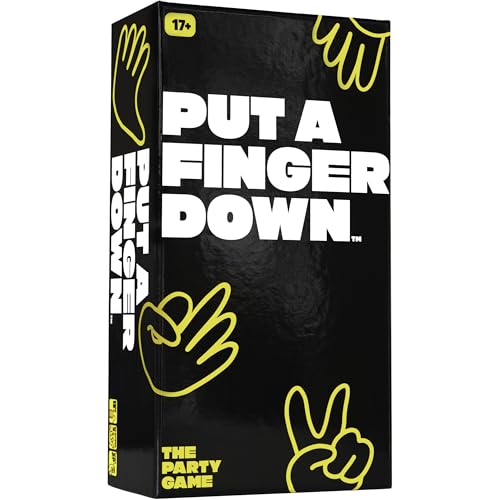
Everyone holds up five fingers, and one person reads a card aloud. Anyone the card fits puts a finger down.
It takes about a minute to explain, and setup is quick since it is just a deck of cards. It works with two people or a full room.
The prompts are what make it fun, because one card tends to turn into a story. “You did that too?” is the usual reaction, and special cards add a few silly twists along the way.
The maker lists it for ages 14 and up and aims it at party groups, so read through the cards first and set aside any that feel off for your table. It is a talking game, not a strategy game, so if you like to plan ahead, one of the games further down will suit you better.
Games You Can Play Alone
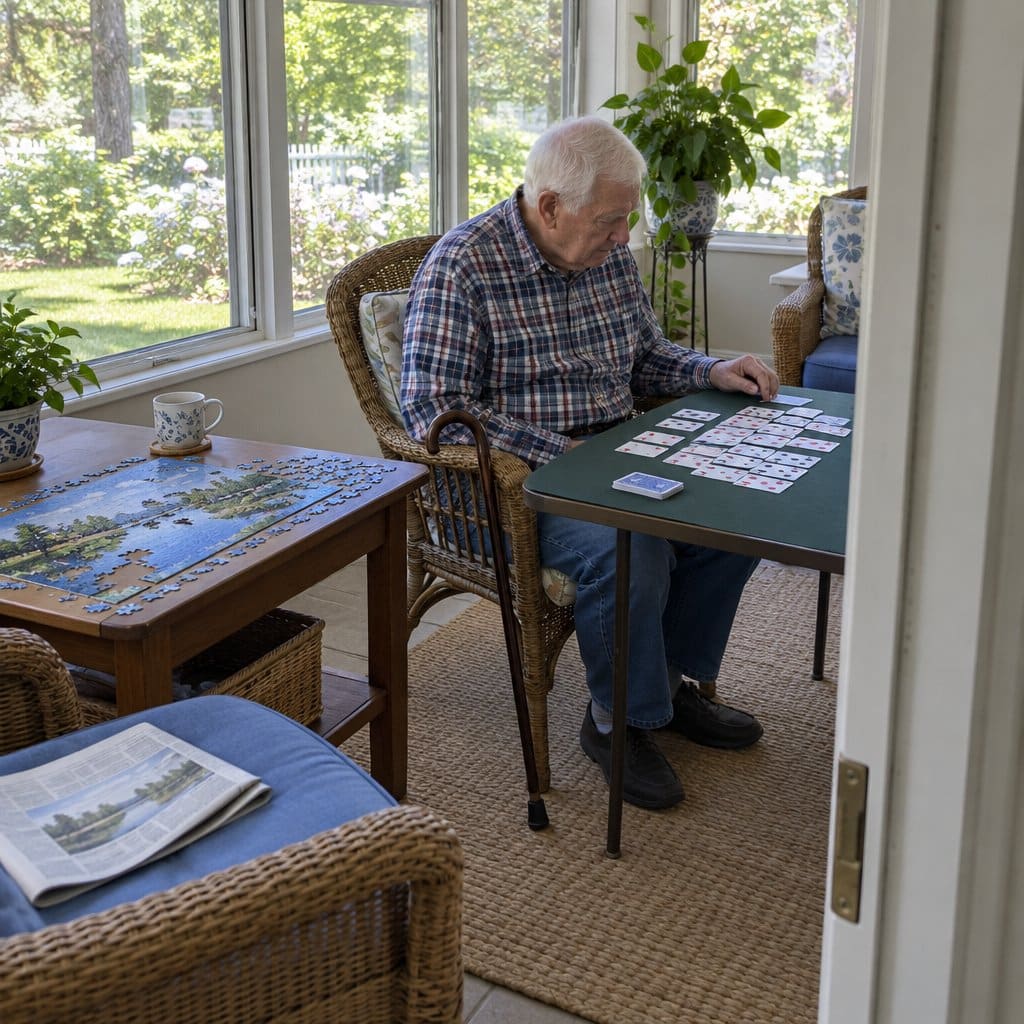
Many older adults find themselves with more alone time than they are used to. Maybe the kids are grown or have moved away. The good news is that plenty of games work fine without a second player, and they can help with alertness, focus, hand-eye coordination and fine motor skills too.
Start with cards. Solitaire is the old favorite, and a computer or tablet opens up rummy, bridge, pinochle and more, games that would normally need other people at the table. I have a list of simple card games for seniors if you want more ideas.
Board games work the same way. Chinese checkers, backgammon, Scrabble, checkers and chess can be played online against other people or against the computer. Hive and Trivial Pursuit are possible that way too.
Dice games are another option. Yahtzee and Farkle both have solo versions. In online versions, one click of the mouse rolls the dice.
Puzzles are the classic solo pastime: word jumbles, mazes, sudoku, crossword and word search puzzles, and jigsaw puzzles. They are also a good fit for bedridden seniors, since there are no cards or dice to lose. If you love puzzles, a puzzle magazine subscription keeps new ones coming. Phone apps and the games already on a computer work too.
A Rubik’s cube asks you to remember patterns and colors and use your hands. For someone with arthritis, turning it can be gentle hand exercise. Go slowly, stop if it hurts, and ask your doctor or therapist if you’re unsure.
Video games were mostly built for solo play. If your loved one liked Atari, a local garage sale may turn up an old system. The Nintendo Wii is senior-friendly, and many of its games need physical movement, so nobody becomes a couch potato. Clear the floor, play near a sturdy chair, and check with the doctor first if balance or falls are a concern.
Outdoor games count too. Croquet can be played alone to practice your skills, and so can frisbee, horseshoes and cornhole. Practicing on your own gets you ready for the next group outing.
The trade-off: games like these are more fun with other people, and online play needs a computer or tablet that your loved one is comfortable using.
Games That Build Attention and Focus
Attention is something you can exercise, and playing regularly is the key. Some of these activities are complex and some are simple, so pick what fits your loved one’s mental sharpness.
Word games get the mind working with words stored up over a lifetime. Scrabble, Upwords and Boggle are good examples, and they nudge people to think about words they have not used in years.
Puzzles are really pattern recognition: you compare a piece’s shape and colors to the picture on the box. Smaller pieces make them harder, and they help with fine motor skills too. For someone with dementia and motor control trouble, look for puzzles made for that purpose. Word puzzle books combine the benefits of word games and standard puzzles.
Card games like Go Fish and Solitaire can hold attention, and playing regularly helps. I have a list of simple card games for seniors if you want more ideas. Games with a bit of chance get a group excited, which helps too.
Checkers is one of the easiest board games, and chess uses the same kind of board with more types of pieces. If your loved one already knows either game, old strategies come back and so do memories. A 3-in-1 set with checkers, chess and backgammon covers all of it.
Reading uses the mind’s eye, imagination and thinking together. If it has been a while, choose something that interests them, at a comfortable reading level. Audiobooks are another route, and audiobook players are easier to use now. Many people listen through comfortable Bluetooth earbuds. Even so, reading print is still worth doing.
Plenty of older adults would rather skip screens and take up macramé, sewing or knitting. If you learn the craft alongside them, they may feel happier and more like they belong, and that alone can lift their thinking. For more on that, see these self-esteem activities for older adults.
Whatever you choose, engaging their mind with different activities on a regular basis is what counts. If your loved one has short-term memory loss, time with you gives them something to look forward to.
The trade-off: some of these, like chess or small-piece puzzles, can frustrate if they are too hard, so match the difficulty to the person.
Magnetic Strategy Game with Stones

This is a magnetic strategy game that comes with 24 full-size stones, 3 ropes and a bag. The stones are big enough to pick up flat-handed, so you don’t need a pinch grip. That helps a lot if arthritis makes small pieces a chore.
The magnets hold the pieces in place. You can play on a lap tray, in a car, or on a surface that isn’t quite level, and the game stays put.
It is quick to teach, which makes it a good pick for a grandparent and grandchild sitting down together. Players of very different ages can join in without a long explanation.
One trade-off: it doesn’t fold shut mid-game the way a clamshell travel chess set does, so you can’t save an unfinished game and carry it away. It also takes up more room packed than a folding magnetic board, so it suits someone who plays at home or in one spot more than someone short on bag space.
Games for Memory Loss and Dementia
Call to Mind Conversation Game

Call to Mind is a board game that has been specifically designed for people suffering from dementia.
The idea of the game is to open the lines of communication in order to get to know a patient who has dementia better. It helps reveal their likes and dislikes as well as other information.
Shake Loose Memory Games

This is another game that has been specifically designed for Alzheimer’s and dementia patients.
The idea of the game is to get the senior to remember certain normal events in everyday life and create a conversation about those events, so you get to know them better and give memory and recall some exercise.
For example, you are asked to keep a card if you have ever jumped into a pile of leaves and whether you remember raking them up.
Keeping Busy Tile Matching Game
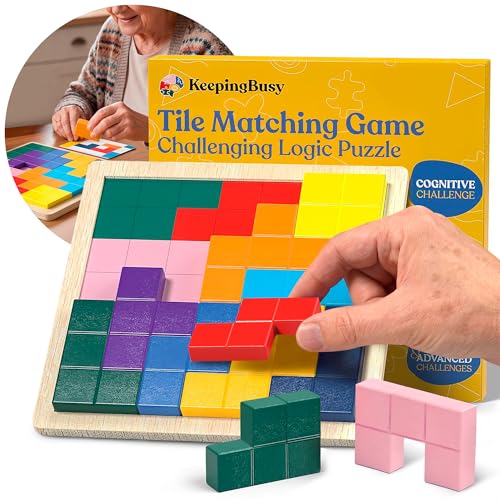

This is a wooden tile-matching kit made for people living with dementia. The person matches chunky wooden tiles to a template, and a caregiver can make the activity easier or harder so it stays something they can finish.
It comes with three difficulty levels. You can pick the one that fits where your loved one is today, then move up or down as things change. The solid-wood pieces are easy to grip and built to handle daily use.
The kit includes 26 templates and a compact storage box, so it works at home or in a memory care setting.
One thing to know: it works best when you start at the right level, and that takes a little judgment from the caregiver at the beginning. Too hard and it frustrates, too easy and it gets ignored. Also, the templates may wear faster than the tiles if they are paper, so expect to look after them if the kit gets used every day.
Simple Board Games for Dementia and Alzheimer's
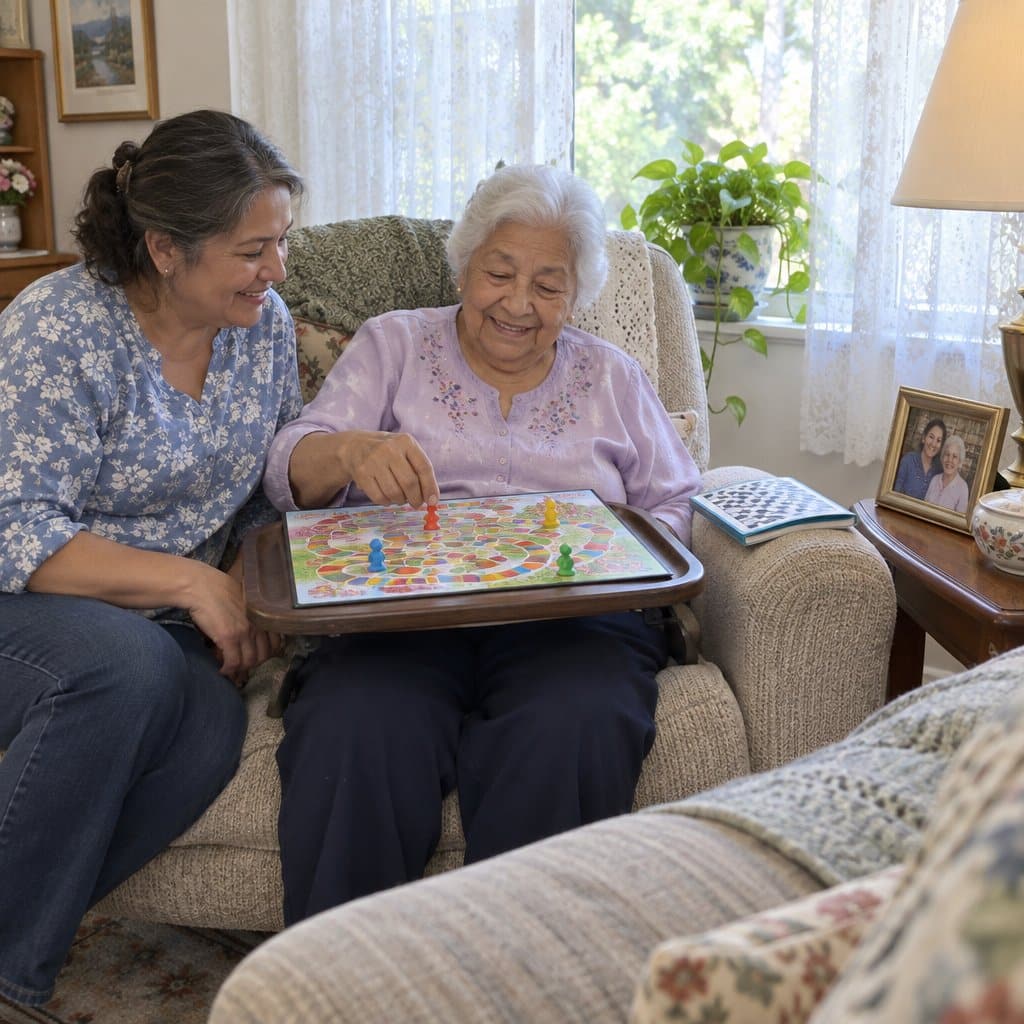
Dementia does not have to end game time. Several board games are easy enough for a person with dementia to enjoy, and playing gives you a way to spend time together. If you want more ideas, I have a guide to games for seniors with dementia.
Start with skill level. Pick a game that fits where your loved one is now, and expect that to change as the dementia progresses.
Candyland, Chutes and Ladders, Trouble, Sorry and Checkers are straightforward to play. They also have no electronics to distract or frighten anyone.
A few kinds of games are best left in the closet:
- Extreme games that take physical exertion, like Twister.
- Games with many small parts that need handling.
- Games with complicated rules.
- Newer-style games with electronic accessories, which can confuse or frustrate.
Light physical activity is a good thing. Drawing in Pictionary or picking up tiles in Scrabble helps hand-eye coordination, as long as the pieces are large or oversized. Hungry Hippos and Chinese Checkers ask for even less: flipping a lever or moving a marble is unlikely to overwhelm anyone. Both use small marbles, though, so stay at the table and skip them if your loved one tends to put things in their mouth. If vision is a problem, look for a large print version. The same thinking applies to gifts for dementia patients.
Choose games your loved one knows from childhood. Many people with dementia remember childhood better than recent events, so Candyland, Hangman or Rummikub may come back easily. They may tell you stories of their youth while you play, which exercises memory too.
Small pieces are a debated point. Some say they overwhelm, and arthritis or Parkinson’s can make them impossible, so Battleship, Mousetrap and Monopoly would be out. Others say rolling dice, moving a piece or spinning a wheel builds hand-eye coordination and the ability to follow directions.
Either way, let them help set up and handle the pieces. Helping a loved one still feel independent and useful matters, and small victories lift morale. Dignity, too, is part of it, as with stylish adult bibs.
For a different kind of game night, a bubble word search game offers a multi-sensory way to exercise the mind. More ideas for making game night fun again are in my other guide.
The trade-off: with small pieces, you may need to pick a different game if hands struggle, so watch how your loved one handles them.
Board games can be a good way for seniors to exercise the brain and keep memory and thinking active.
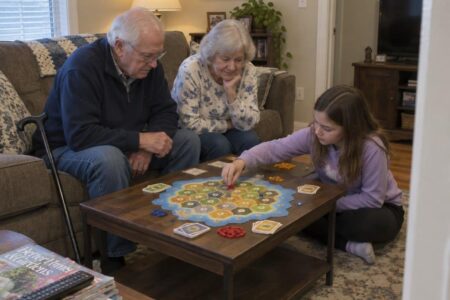
However, the greatest benefit of board games is that they are interactive and allow a senior to communicate and socialize with family, friends, or caregivers to prevent them from feeling alone and isolated.
You can learn more about the best games for seniors with dementia in this guide.
What’s your favorite board game to play? If you’ve found one that works particularly well for your loved ones who are seniors, please share below! I’d love to hear about your experience.



My company is currently in the process of opening a senior activity center. I’m looking for the most popular board games, books & activities for my clients. Any suggestions would be very helpful
thank you
Karen Ondrejack