For those who wear hearing aids, finding comfortable headphones that don’t interfere with or cause feedback on your devices can be a challenge.
Because earbuds are not a choice for you, the key is to look for over-ear wireless headphones with noise cancellation. Brands like Bose and Sony make excellent noise-canceling Bluetooth headphones that are comfortable with hearing aids. Their soft, cushioned ear cups avoid putting pressure on your ears. And, there’s also no cable to trip you up.
Bone-conduction headphones like AfterShokz are also a great option because they don’t cover your ears at all. The open design allows you to wear them with hearing aids easily.
Focus on comfort, noise cancellation to block background noise, and wireless connectivity when choosing headphones to use with your hearing aids.
If you’re short on time, the picks below are the ones I’d point you to first, and I explain each one further down the page.



Best Hearing Aid Compatible Headphones to Consider
Based on the features I described above, here are some of the best Bluetooth headphones for hearing aid wearers, depending on the type of hearing aid you have.
Bose QuietComfort Noise Cancelling Headphones
These Bose headphones may be pricey, but they are perfect for those who suffer from hearing loss. The headphones are some of the most comfortable in the marketplace and offer the exceptional sound quality that Bose is known for.
With cushioning on the ear-cups that would satisfy those with even the most sensitive ears, you may even forget that you are wearing earphones altogether.
No one does noise cancellation better than Bose. Bose has been and continues to be the leader in pioneering intelligent noise-cancellation technology.
With this model specifically, you get built-in noise technology that can silence the ambient noise surrounding you while boosting bass and higher frequency treble sound waves.
Whether you are looking to limit noise on the airplane or on a busy metro, you will be able to listen to media and music at lower volumes than ever before.
Bose does this using proprietary technology to clear away the noise surrounding you so you can get an optimized listening experience at safe volume levels.
This is one that can be very useful for a senior. Having both Google Assistant and Amazon’s Alexa built-in make using the headphones and playing the media you want a breeze. Simple voice commands and you will be off watching your favorite soap opera or listening to your favorite song.
Sony WH1000XM3 Noise Cancelling Headphones
Sony has been making a lot of strides to put itself almost on par with Bose in the noise-canceling headphones department. In some ways, the WH-1000XM3 surpasses Bose’s efforts.
While these headphones are expensive, they offer high levels of compatibility for seniors with hearing aids and the listening experience is incredible.
This model features their brand new noise cancellation processor which allows the headphones to complete on-site analysis based on the characteristics caused by your glasses and hearing aid. After all, you won’t have a tight seal depending on the hearing aid that you are wearing.
Therefore, Sony’s ability to customize noise cancellation to your own experience can actually surpass what the Bose headphones are capable of delivering.
These headphones deliver a comfortable wearing experience with deep, ergonomic ear space to completely cover the ear canal. This is important for those who wear protruding hearing aids because you don’t want a tight fit causing pain in your ears.
Also, Sony has delivered incredibly comfortable and very soft pressure-relieving pads which evenly distribute pressure to avoid your ears experiencing discomfort when worn over longer periods of time.

Sony WH-CH520 Wireless Headphones

If you want a simple pair of wireless headphones for TV, music, or phone calls, the Sony WH-CH520 is worth a look.
The battery is the main selling point. It runs up to 50 hours, and quick charging means a short plug-in gets you back to listening. It charges with a USB Type-C cable, which comes in the box.
The ear pads are soft, the headband adjusts, and the earcups swivel so they slip on and off easily. Sony describes the build as lightweight and made for all-day comfort. That matters if you wear hearing aids, since anything pressing on them gets tiresome fast.
There is a built-in microphone for hands-free calls, so your phone can stay in your pocket. Multipoint connection lets it stay paired with two devices at once, say your phone and your tablet, and switch between them.
You can adjust the sound to your liking with the EQ Custom setting in Sony’s Headphones Connect app. It also boosts the quality of compressed music files.
The trade-off: this model does not list noise cancellation. If a houseful of grandkids is the problem, these won’t shut the noise out the way a noise-cancelling pair would. And the app is how you get at the sound settings, so it suits you best if you’re comfortable with a phone app.
It comes in six colors: Black, Blue, White, Pink, Yellow and Cappuccino.
SHOKZ OPENRUN Bone Conduction Headphones
These may look odd if you haven’t seen bone conduction headphones before, but they suit hearing aid wearers better than you’d expect.
The SHOKZ OPENRUN sends sound through the bones of your face instead of through the ear canal. It connects wirelessly over Bluetooth, so there’s no cord to snag.
That matters if you wear hearing aids. Since the sound doesn’t need to go into your ear, the headphones aren’t fighting your hearing aids for the same space. Sound also tends to stay clearer than it does when you stack one device on top of another.
Bone conduction also lets you hear the room around you, such as the doorbell, a car, or someone calling your name. That’s a real safety plus for walks.
The trade-off is that bone conduction usually doesn’t sound as full as regular headphones, especially in the bass. In a loud place, like a busy street, it can be hard to hear.
It also won’t suit everyone. If your hearing loss is significant, it may not get loud enough for you. Ask your audiologist whether bone conduction makes sense for your type of hearing loss before you buy.
Beats EP Wired Headphones

This is one of the standout on-ear efforts from Beats available at an affordable price. Because they are on-ear headphones, you want to be sure they will be compatible with your specific type of hearing aid.
On-ear headphones are likely to be less comfortable depending on what type of hearing aid you have. If you are looking for wired headphones to avoid dealing with the hassle of charging your headphones constantly, this is a good option.
As long as they are compatible with your hearing aids, they offer a comfortable wearing experience. You can adjust the headband, and they are extremely lightweight.
Beats is known for delivering some of the best-sounding headphones. These headphones offer a premium listening experience and plenty of volume for those hard of hearing.
While they don’t look like they were designed for seniors, they certainly sound like it. Plus, you will look like the trendiest senior on the block!

Alternative to Bluetooth Headphones for Voice Clarity
Swiitech Wireless TV Headphones
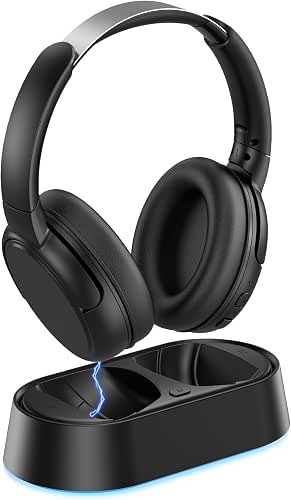

The Swiitech Wireless Headphones for TV Watching come with a transmitter that doubles as a charging base. You plug it into the TV once with a single cable, and that’s the whole setup. No app, no pairing codes.
What stands out for an older adult is the dialogue enhancement, which pushes voices forward so speech is easier to follow. The headphones also let you set your own volume, so the rest of the house isn’t stuck listening to a loud TV. The battery runs about 24 hours, and the dock pairs them automatically when you set them back down, so they’re ready next time.
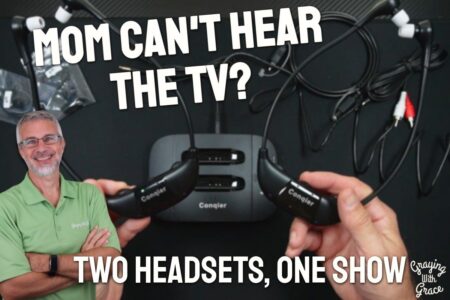
If you and your spouse watch shows together, I also demoed the Conqier Dual TV wireless headphones, which lets two people each set their own volume.
If you would rather not wear anything on your head, a wireless TV speaker for hard of hearing seniors can make dialogue clearer without turning the volume up.
The trade-off is that the sound is tuned for TV speech, not music. If you want headphones for listening to albums, look elsewhere. Your TV also needs an optical, RCA, or AUX output. Bluetooth is a backup, but on an older set it adds a step.
Features to Look for in Headphones (Over and On-Ear Headphones)

1. Noise Cancellation
This should be one of the very first things that you look for when you purchase headphones that would not only be compatible with hearing aids, but that may enhance your listening experience.
Noise cancellation is easily one of the most sought-after features, even among those without hearing loss.
Blocking out ambient noise can make it much easier to listen to music and media at the lowest possible volume. This alone can make these headphones better suited for preventing further hearing loss.
However, for those with established hearing loss, it can make it much easier to distinguish sounds.
While this feature is most prominently found on over-ear headphones, you are starting to see it come to more models. Another benefit for seniors is that this feature can silence crying babies!
Whether you are on a plane or dealing with your loving grandkids, finally you can have some peace and quiet.
2. Comfort
The comfort of the headphones is going to be paramount. As someone older, you may have sensitive ears enough as it is. When you add your hearing aid to the equation, things can get very uncomfortable in a hurry.
The ideal type of headphones you should look for will vary depending on the type of hearing aid you wear. Those who wear in-the-ear hearing aids and other styles that don’t protrude will leave you with many more options.
For those who wear behind-the-ear hearing aids, you will likely be much more limited in headphones regarding the comfort they can provide.

3. Accessibility
Accessibility is going to be important for anyone who is less accustomed to using technology. As a senior, you likely have a difficult enough time as it is learning the nuances of every new gadget. The last thing you want is for your earphones to complicate your life.
Luckily, various earphone models are available that offer simplicity in their operation. Whether it comes from intuitive touch controls or a set-it-and-forget-it connection setting, you want to find earphones that aren’t going to force you to fiddle with everything constantly.
4. Volume
The volume is another consideration you must factor into your buying decision. Ideally, you want to find headphones that will output the volume you need for your respective hearing situation.
That being said, you shouldn’t prioritize finding headphones with the highest volume settings.
Instead, you would be better off prioritizing and purchasing headphones that can decrease ambient sounds and noise. That way, you can get the same listening experience at lower volume levels rather than fighting against ambient noise altogether.
4. Long Battery Life
Of course, you want to choose a pair of headphones with long-lasting rechargeable battery so they are always ready to use when you want them. Look closely at the charging process and ensure it is a system you can easily implement. Charging docks are easier to manage than cords that plug into the headphones.
If you can wear earbuds and want something that rarely needs charging, take a look at the PocBuds earbuds with a digital battery display.
Summary and Final Recommendations
Just because you wear hearing aids doesn’t mean you can’t find a comfortable and compatible pair of headphones. There are so many available nowadays.
The key is finding one that delivers in the comfort department. This will vary depending on the type of hearing aids you wear. Use the criteria above and look at some of the standout models mentioned, and you should be able to find the perfect headphones.