
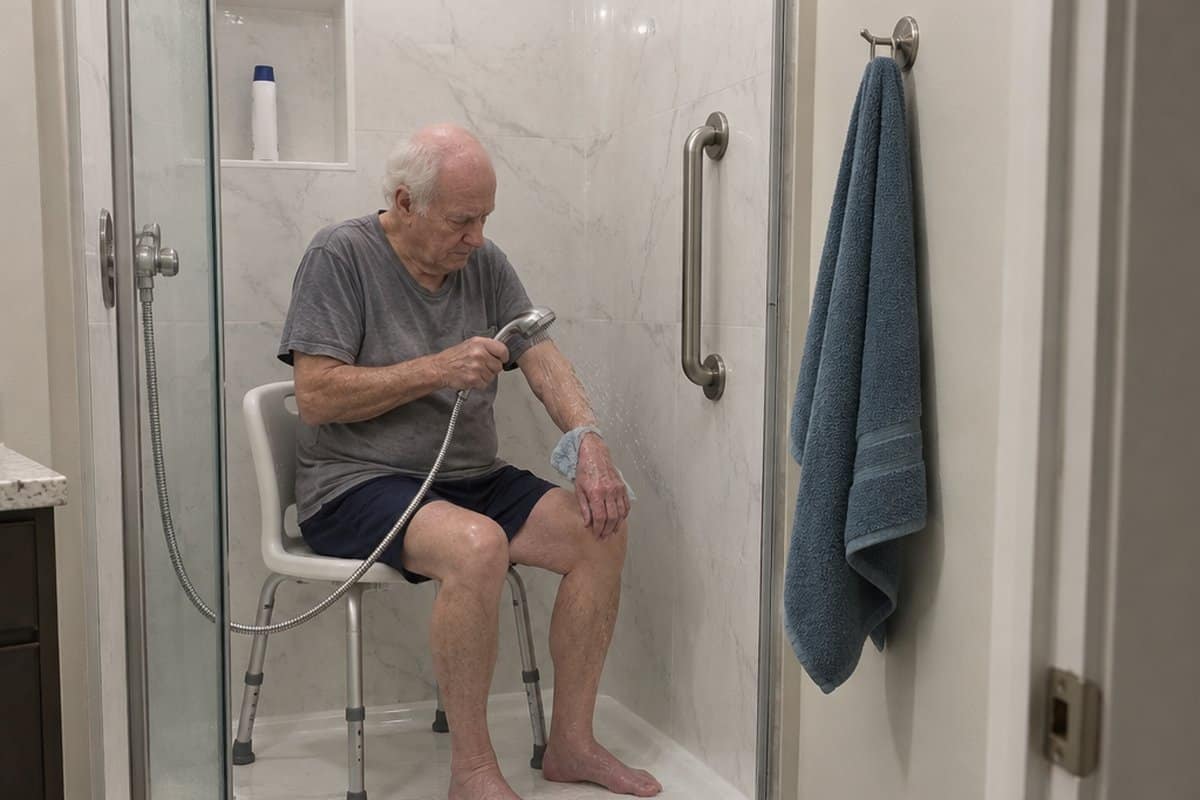
You reach for the shower wall to steady yourself, and it hits you that the bathroom is a risky room. This guide to the best bathroom safety products for seniors is meant to help you and the people who worry about you.
We cover the shower and tub, toilet help, grab bars, slippery floors, water temperature, and what to do after a fall. We also point out the downsides of each fix, so you do not waste your money.


Where in the Bathroom Do You Need the Most Help?
People need different amounts of help in the bathroom. You should identify the common hazards in the bathroom and prioritize them based on your situation.
First, you might have a little trouble getting up and down from the toilet.
Then, maybe you need someone’s help to take a shower.
Sometimes, your need progresses, and what works one day may not work the next.

I recommend that you check with your doctor or therapist before using any bathroom equipment. They know your individual medical situation and can help with your decision.
Scott Grant, SHSS®, CSA®, ATP
Seven Hidden Bathroom Danger Zones and a Simple Fix for Each
Bathroom falls are a leading cause of in-home injuries for older adults, and many happen to people who thought they were being careful. The room is not one big risk. It is seven smaller ones, and none of the fixes needs a contractor.
Try a quick mental walkthrough of your own bathroom as you read. You will probably spot at least one thing you never thought about.
Zone 1, the shower entry step. The edge is often wet, sometimes raised, and the same color as the tile. When vision or depth perception has changed, it can be nearly invisible. You also stop looking for a step you have used for years, and that is when you misjudge it. A contrast-color strip on the edge fixes both problems.
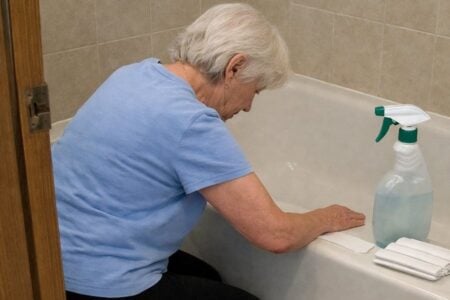
Zone 2, the wet floor outside the tub. Lift one corner of your mat. If it comes up easily, replace it with a non-slip bath mat with strong suction cup coverage.
Zone 3, the toilet. Height is the real problem. Pushing up from a low seat strains your knees and hips, and mornings are often the stiffest. A toilet riser adds 3 to 5 inches, needs no tools, and some have built-in armrests.
Zones 4 and 5, the towel bar and shower curtain. Both are the first things you grab when you slip, and neither holds your weight. A towel bar can pull out of the drywall. A curtain rod comes down with you.
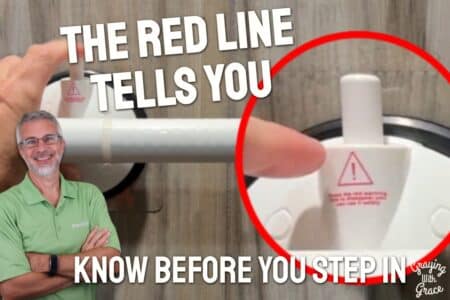
Add a real grab bar nearby, so the towel bar is never your only option. If you do not want to drill, a suction cup grab bar is one choice. It can help you steady yourself, but do not count on it to hold your full weight in a fall. Look for large suction cups, a locking lever, and a weight rating of at least 250 pounds. Press firmly and try to release the cup before you ever lean on it.
Zone 6, the dark bathroom at night. Low baseboard-level lighting is the answer. The bedroom changes that prevent nighttime falls follow the same idea: close the specific gaps rather than overhaul the room.
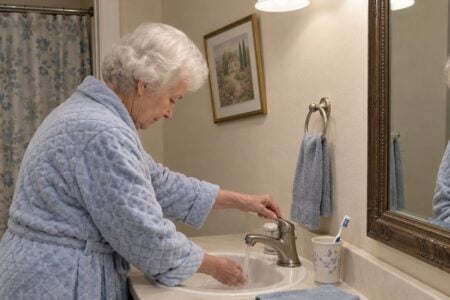
Zone 7, the vanity lean. Leaning toward the mirror to take medication or rinse your face shifts your center of gravity without warning. If you are dealing with balance challenges, that moment can be enough. A small grab rail near the sink gives you something to steady against. It does not need to be fancy.
If you want to go further, read about what to do after a senior falls and how to make your home safer room by room. If you are helping a parent, this 9-question checklist for assisted living decisions can help you tell whether the home needs modifications or more support.
Pick the one zone that made you pause and fix it this week. One trade-off: these small fixes close specific gaps, but they will not replace a seat or a bar bolted into the wall if standing is the real trouble.
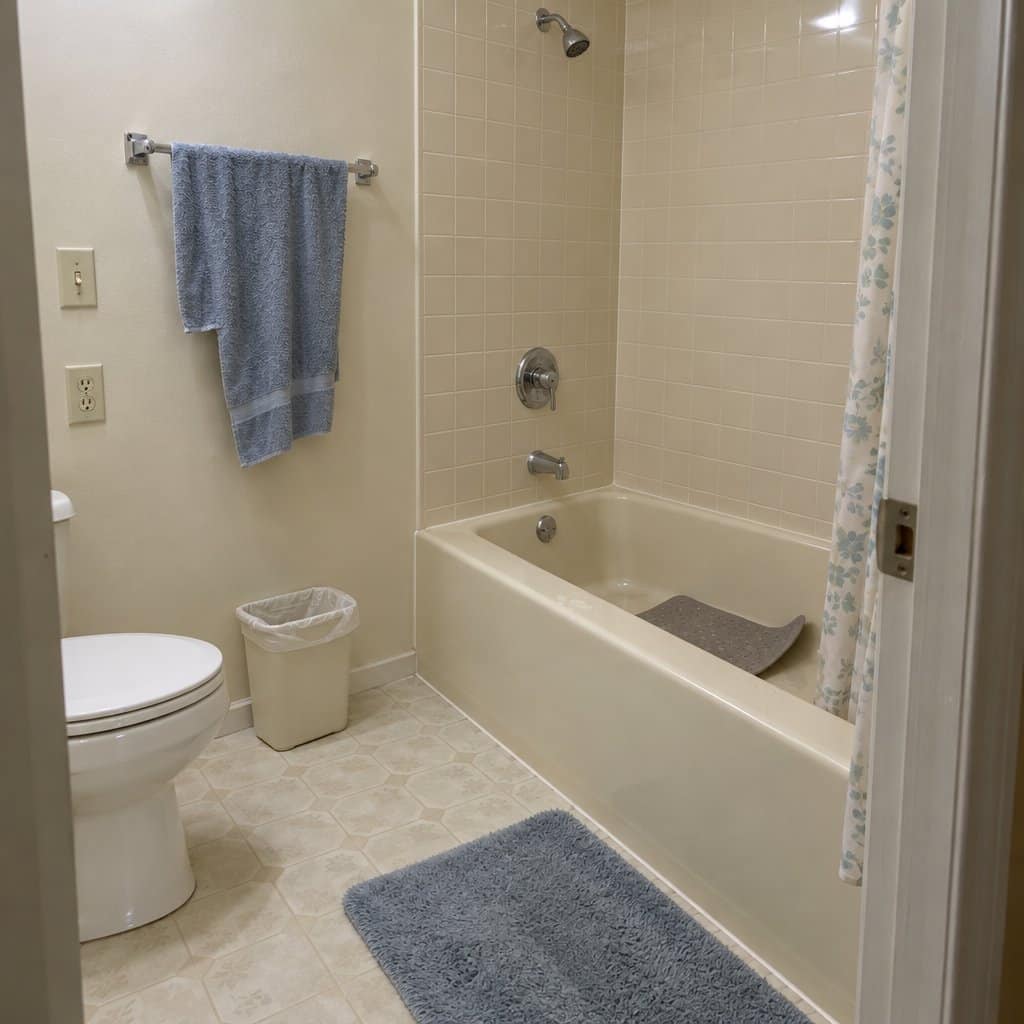
Common Bathroom Hazards and Injuries for Older Adults
The bathroom combines slippery floors, hard surfaces and a higher chance of falling. That is why it is one of the most dangerous rooms for older adults. The CDC reports falls are the leading cause of injury-related death among older adults.
The most common injuries are falls, slips and fractures. Bruises, head trauma and dislocations follow.
Here are the hazards to look for, and what helps with each:
- Slippery or wet floors: keep floors dry and clean, use non-skid bath mats, and wear non-slip shoes.
- Loose rugs: remove decorative rugs and keep a clear path to the toilet. Any mat needs a non-slip backing.
- Poor lighting: use bright white bulbs, plus nightlights and motion sensor lights at night.
- Weak or improper grab bars: replace suction cup handles and towel bars with secure grab bars, installed by the manufacturer’s directions.
- Scalding water: set the water heater to a safe temperature, and adjust the water temperature before getting in.
- Clutter: clear toiletries and knick-knacks off the tank, sink and tub edges, and keep trash cans off the floor.
- Mold, mildew and soap scum: ventilate the room and clean often. Soap scum makes surfaces slick.
- Electrical and plumbing trouble: have a licensed electrician check for GFCI outlets in wet areas, and fix leaks right away.
- High thresholds: replace any threshold more than 1 inch high.
- Low or loose toilets: tighten or replace a loose toilet. Add an elevated toilet seat and toilet grab bars.
Teach your loved one to spot these hazards on their own. Caregivers should do spot checks now and then so the room stays safe.
Many older people also have weaker immune systems, which makes mold and germs a bigger worry. An unclean bathroom is a real hazard.
One trade-off: no list catches everything, and a bathroom changes over time. Recheck it regularly.
1. Getting In and Out of the Shower and Tub
When you have balance or joint problems in your legs, stepping over the edge of a standard or garden tub is a real problem.
If lifting your leg is difficult, and it catches on the edge of the tub, a fall could easily happen. You might not have a place to brace yourself either.
In addition to an injury, maybe you worry about having an accident in the bathroom and someone having to help you while naked and in a delicate position.
There are many options that assist you with getting in and out of the shower and tub more safely:
- Grab bars can help a senior stabilize themselves while they raise their leg over the tub edge. These bars are often mounted to walls and offer maximum security when installed correctly.
- Clamp-on tub bars are also available that mount to the tub edge.
- Suction cup grab bars are an option if you do not want to drill holes in your shower. They help you steady yourself, but they should not be trusted to hold your full weight in a fall.
- Walk-in tubs are a permanent option. A tub transfer bench is a lower-cost choice that lets you slide in and out from a seated position.

2. Standing Long Enough to Take a Shower
Standing to take a shower is very dangerous for some elderly because of weakness or poor balance.
A few options that help with getting in and out of the tub also help with showering more safely as well:
- Grab bars are used as a base of support if the elderly patient has minimal difficulty standing.
- The transfer bench discussed above is also usable as a shower seat.
- Shower chairs are seats that are usually plastic that you can place in the shower or tub and sit on while showering. Shower chairs come in many options, from plain, small benches to elaborate thrones with backs, arms, and cushions.
Once a safe position for showering is set, consider these ideas too:
- Non-slip bathtub mats are necessary to prevent slips and falls from a wet tub surface.
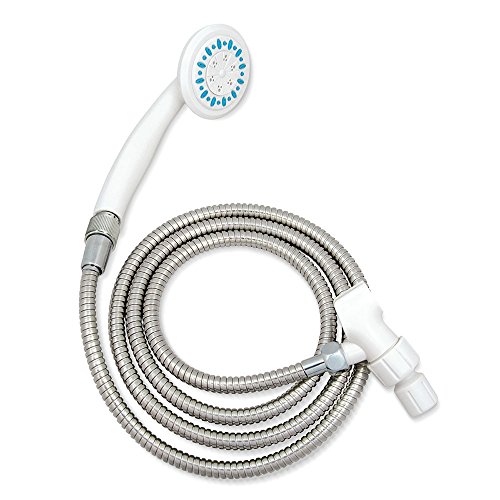
- Handheld shower heads with long tubing are very important. These allow the senior to shower without having to reach or stretch. The best ones have easy controls and long, tangle-free tubing.
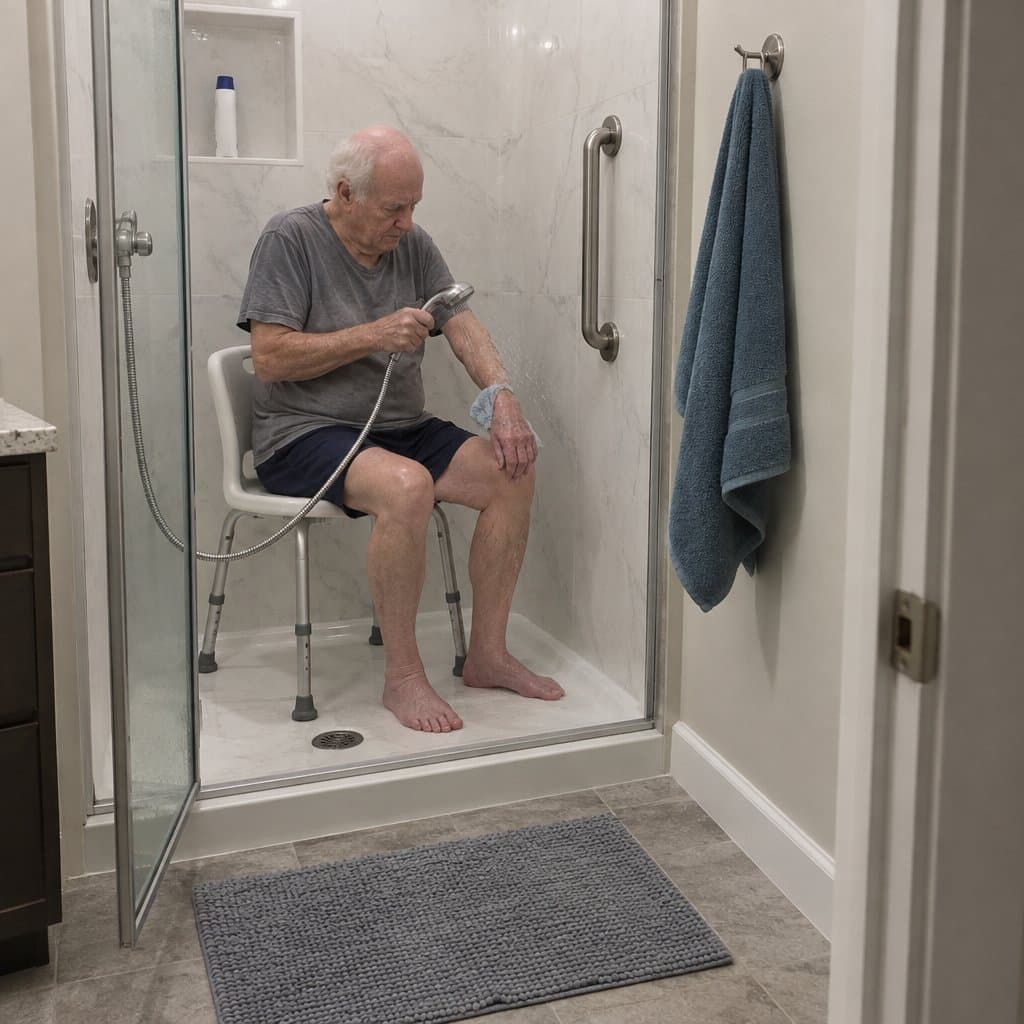
Setting Up a Safe Shower: Clutter, Shower Shoes and Weighted Curtains
Some of the best shower fixes cost little effort. Start with the clutter.
Next, the floor. Soap and shampoo can make the shower floor very slick. Bathtub stickers help, and I don’t mean the kiddie fish kind, because there are grown-up styles. You can also paint on a non-slip coating on the shower floor. If you want something more permanent, non-slip tiles are an option.
Shower shoes are another idea. Most people think of them for public showers, but the non-slip soles work at home too. They matter most if your shower floor is not already non-slip. I cover them in my guide to shower shoes for seniors.
If you have a shower and tub combination, a weighted shower curtain helps. It has weights sewn into the bottom hem, so it stays against the side of the tub and keeps water off the floor. A dry floor means fewer slips. If you use a tub transfer bench, a split shower curtain keeps water from splashing out.
Avoid decorative rugs on the bathroom floor, because they don’t have a non-slip backing.
A waterproof medical alert system is worth considering too. It should be easy to use and let you call for emergency help with one touch. Or you can keep a wearable alert button on your body in the shower. If a fall does happen, here is what to do after falling in the shower.
If a regular shower no longer works, a portable shower is another route. It can go in a bedroom if there is enough space, it is wheelchair accessible, and set-up only needs an attachment to the sink. It is also less of a project than remodeling the bathroom.
The trade-off is that a caddy, shoes and a curtain only lower the risk. They don’t replace a seat or grab bars if standing is the real problem.
Shower Problems and Fixes: Memory, Vision, Dizziness and Medications
Not every shower problem is a slippery floor. Some come from how a person sees, thinks or feels that day. Here are the common ones and what helps.
Trouble standing for long. A shower chair or a transfer bench lets you sit. Grab bars also help with balance. If you are tired or dizzy, sitting down to wash is the simplest fix.
Memory loss or dementia. Post clear instructions or reminders for the steps of showering. Labels or pictures placed near the faucet can make it easier to understand what to do.
Vision problems. Use contrasting colors for grab bars, non-slip mats and other things in the shower. When they stand out from the wall and floor, they are easier to see.
Medication side effects. Some medications can cause dizziness, confusion and other effects that change how safe a shower is. Talk with a doctor or pharmacist if you have concerns.
Hard to step into the tub. A barrier-free walk-in shower means no tub edge to step over. My comparison of tubs versus showers goes through the choice. Grab bars also help with getting in and out.
Not enough support. Put more than one grab bar in the shower, especially near the entrance. A shower chair adds support too.
A cramped or cluttered bathroom. Keep the room roomy, tidy and free of clutter. Remove trip hazards and anything unnecessary from the floor and the shower area.
A handheld shower head with several spray settings and an adjustable mount gives you flexibility. If you are helping someone who has put off washing, my article on why some older adults stop bathing may help you see why.
One trade-off: no single fix covers every challenge. A person with poor vision and dizziness may need several of these working together.
Faucets, Water Temperature and Scald Protection
A faucet is easy to overlook when you think about bathroom safety. It matters most if arthritis or a weak grip makes your hands struggle with it.
Knob-style handles take a firm twist. Lever-style faucet handles take less force. You push or pull the lever to change the water flow, so no tight grip is needed.
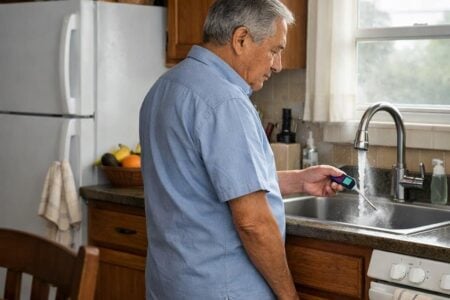
Scalding is the other worry. A temperature-regulating faucet keeps the water from reaching a heat that could burn your skin. It holds the water at a safe, steady temperature, so you can use the sink without worrying.
If you care for someone else, check your water heater. Make sure it is not set too high, because that is another way to prevent scalds. If you want to keep a loved one comfortable while bathing, my guide on keeping the elderly warm while bathing covers the water temperature side of it.
These faucets are often easy to put in, which can save on installation fees. Still, they only help at the sink or tub where they are fitted, so a lever handle does nothing for the shower you already have.
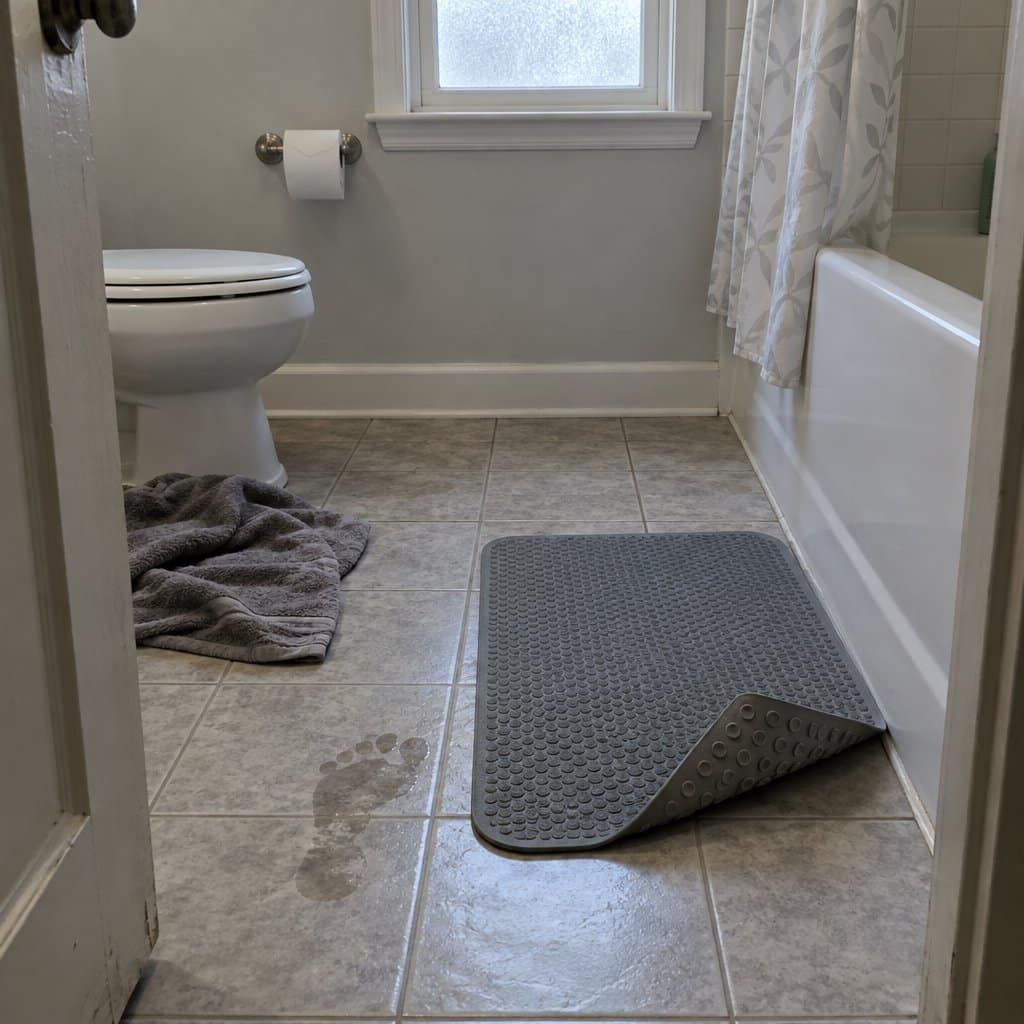
Making the Wet Floor Less Slippery
The wet floor just outside the shower or tub is where a lot of slips begin. Many people own a decorative bath mat that absorbs a little water and looks nice. But the edges curl, the suction cups weaken over time, and the mat slides slightly when you step on it at an angle.
That small slide is all it takes.
Here is a quick test. Lift one corner of your current mat. If it comes up easily, it no longer has enough suction, and it is time to replace it.
When you shop for a non-slip bath mat with strong suction cup coverage, look for three things:
- Dense suction cups across the entire base, not just the edges.
- Enough weight that it does not float when wet.
- A textured surface that grips even when a wet foot lands off-center.
A good mat is one of the most helpful upgrades you can make in a bathroom.
The step into the shower deserves a look too. The edge is often wet, sometimes raised, and usually the same color as the tile around it. Contrast-color threshold strips on that edge make it easy to see and add grip right where you need it.
One trade-off: a mat only helps while it stays stuck down. Check it every so often, because a mat that has gone loose can do more harm than having none.
Where to Put Grab Bars and What Not to Trust
Grab bars only help if they are in the right spot. Three places matter most: inside the shower or tub, at the tub entry, and beside the toilet.
Inside the tub, a diagonal bar along the side wall works well. It gives you something solid to grip both while lowering and while rising.
At the tub entry, a bar supports you while stepping in and out. Beside the toilet, a horizontal bar at seat height does the job.
If you only add two, put one beside the toilet and one inside the shower or tub. Those cover the two riskiest moments in the bathroom.
A decorative towel bar is not a grab bar. Towel bars are not rated for body weight, and they can pull out of drywall anchors under the pressure of a fall, which is exactly when you need them.
A true grab bar should be rated for at least 250 to 300 pounds of force. Look for a rust-resistant finish such as chrome or stainless, and for ADA compliance, which tells you it meets safety engineering standards.
It should also be anchored into wall studs, or with proper toggle anchors on tile walls.
Bars fastened to the wall are the most secure. If you rent or are not ready to drill, a tension-mounted bar that fits between floor and ceiling is a reasonable stopgap, though not as sturdy.
A grab bar steadies you, but it does not dry a wet floor or give you a seat. Pair it with a non-slip bath mat, and if you would rather sit to bathe, a shower chair is worth a look too.
3. Wanting to Take a REAL Bath?
Once you begin having physical difficulties, taking a submerged bath seems impossible.
Baths have great benefits too, like soaking tired muscles and achy joints and creating a general state of relaxation.
But you can still benefit from a bath too! And bath lifts can help.
A bath lift slowly lowers you into a tub full of water. Then, it raises you up again at the touch of a button. Most have safety features too to prevent you from getting stuck in a tub full of cold water.
See some of my list of the best bathtub lifts in this guide.

Which Type of Shower or Tub Is Safest?
Some shower designs are riskier than others. The standard shower and tub combination found in most homes is one of them.
You have to lift your legs over the edge of the tub and then stand inside it to shower. One misstep can mean a lost balance, a trip, a slip, or a fall.
A walk-in shower with no tub is a better choice, because there is no high wall to step over. Ideally it has no threshold at all.
That suits people who use a walker or a wheelchair, and people who have trouble lifting their legs even a few inches.
If you are choosing or remodeling, look for a seat, a non-slip floor, support rails, and built-in ledges to keep bath bottles off the floor. Sometimes an old shower and tub combination can be remodeled into a walk-in shower.
Whichever you have, the same helpers apply: grab bars, a shower chair, a handheld shower head, and shower shoes with non-slip soles. If a fall does happen, here is what to do after falling in the shower.
If the traditional shower no longer works, there are other ways to bathe.
A walk-in tub has a side door you open to step in and out. It has built-in seating, so you spend less time on your feet. Water jets can ease stiff joints and tired muscles.
A portable shower can be set up in a bedroom if there is enough space. It is wheelchair accessible, and set-up only needs an attachment to the sink.
If getting out of bed is hard, a sponge bath in bed works. It usually needs some help from a caregiver.
The trade-off is that remodeling or converting a tub takes space and planning. How you go about it depends on the room you have in your bathroom.
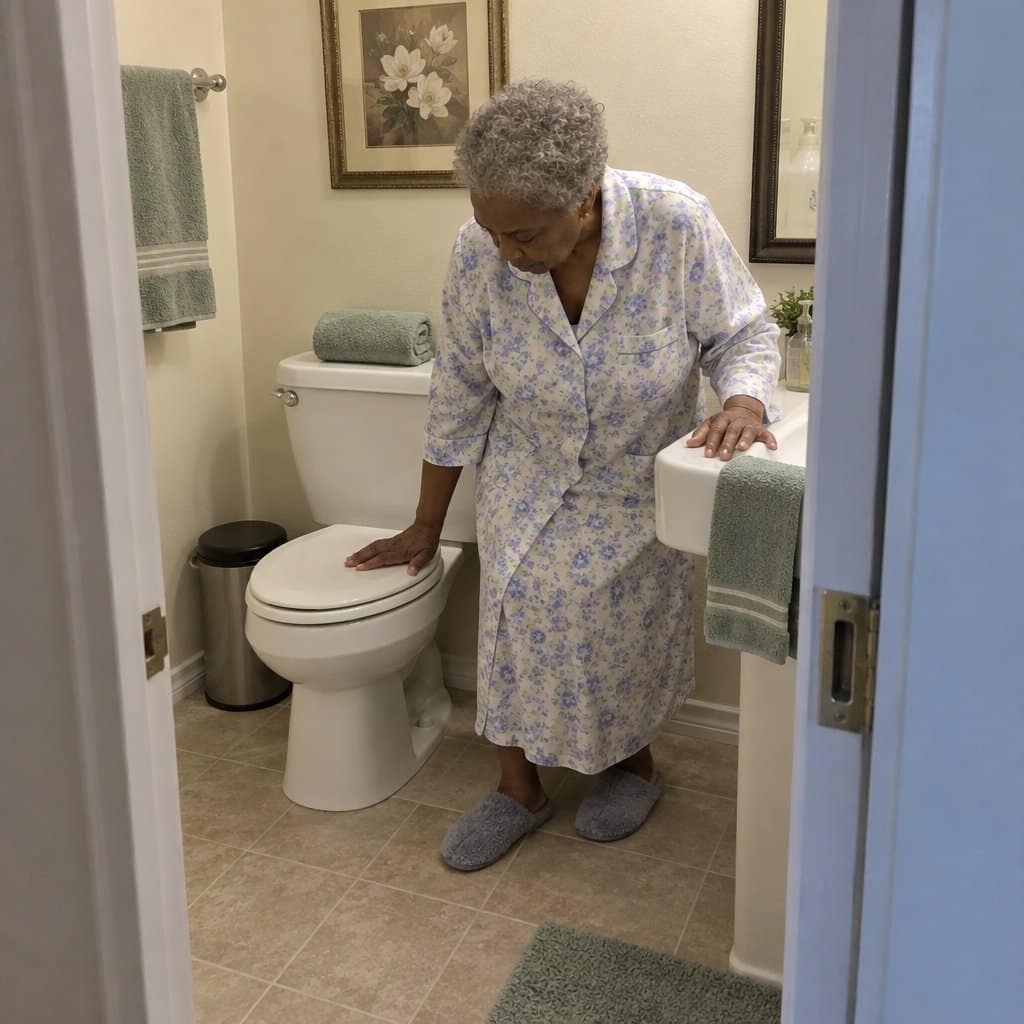
4. Getting Off and On a Toilet
Getting up and down from the toilet seat requires good balance and leg strength. You need good leg strength to stand up from the seated position. But, you also need great balance to keep from falling forward or to the side.
To help you with this, consider the following bathroom aids
- Raised toilet seats clamp right onto the toilet bowl, giving you a higher seat. They also come with and without arms, depending on what you need. See my list of the best raised toilet seats for more info.
- Toilet safety rails mount to the toilet too. They help by giving you nice, high arms that make it easier to push up to a standing position. Sitting is easier too because you can use them to steady yourself. Learn more about these in my guide to the best toilet safety rails.
- Combine a raised toilet seat with toilet rails if you have significant trouble using the toilet.
- 3 in 1 commodes, aka bedside commodes or potty chairs, are extremely helpful too. While they are usually used in the bedroom, you can use them over toilet seats too. Just adjust the legs to the height you need, remove the bucket underneath, and then straddle it right over your toilet.
5. Cleaning Up After Toileting
Cleaning yourself up after using the toilet might cause you pain. Or, it might be nearly impossible to do at all.
Reaching around with an arthritic shoulder or elbow is painful. Maintaining your balance while cleaning could risk a fall.
But there are several product options that can help here too. Here are some of my favorites:
- Wet wipes are often the simplest option. They require less force than toilet paper. So, they are easier and quicker to use.
- Toilet safety rails can help here too. They give you a place to hold on to and steady yourself while wiping.
- Wiping aids are also available. These devices are basically curved wands that hold toilet paper at one end. You use the wand like an extension of your hand for cleaning yourself.
- Bidets are also extremely helpful too. And, the great news is you don’t have to go through the hassle of installing one. There are several devices out there that clip right onto the toilet in just minutes.

A Starter Checklist for Caregivers: Five Aids That Protect Independence
Say your mom mentioned she steadied herself on the towel rack getting out of the tub. Or you noticed she is taking longer in the bathroom than she used to. You are not overreacting. Noticing is what good caregiving looks like.
Most falls do not happen in dramatic moments. They happen in routine ones: stepping out of the shower, lowering onto the toilet, reaching for the soap. Five aids cover those moments, and none of them has to feel medical.
Grab bars come first. Put one beside the toilet and one inside the shower or tub, and that covers the two riskiest moments right away. Think of them like handrails on a staircase. Nobody takes a stair rail as a sign of decline. It is just smart design.
Second, a raised toilet seat. A standard toilet sits about 15 inches off the floor, which is a long way down and back up with arthritis or reduced leg strength. A raised seat adds 2 to 6 inches. Choose one with armrests, check that it fits a round or elongated bowl, and check the weight capacity. Locking models are the most reliable.
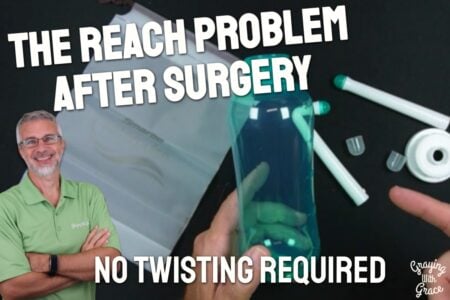
Third, a toilet wiping aid. This is a long-handled tool that holds toilet paper or a wet wipe, usually with a grip-release so hands never touch the paper. It helps after hip or back surgery, or with arthritis in the hands, wrists or shoulders. Many people struggle here and say nothing, so bring it up before it becomes a point of shame. Present it as a practical comfort tool, like a jar opener.
Fourth, a non-slip bath mat. Use one inside the tub and one just outside it. Look for full suction cup coverage, mold and mildew resistance, a size that fits the tub floor, and a machine-washable mat. If your parent says it looks clinical, point out that hotel rooms have them, and many now come in colors and patterns.
Fifth, a long-handled bath sponge. It extends reach by 12 to 18 inches or more, so the back, feet and lower legs get clean without bending or twisting. A bendable handle helps most. If your parent prefers to sit, pair it with a shower chair.
You do not need to do all five at once. If you want one place to start, begin with the mat, then add the others over a few weeks. For the rest of the house, my fall prevention checklist goes room by room.
One trade-off: these aids make the bathroom safer, but they will not replace a seat or a bolted-in bar if standing itself is the real trouble.
Carex Bathtub Rail
The Carex Bathtub Rail clamps onto the side of the tub, so there is no drilling and no tools. You tighten it by hand, and it goes on in under 5 minutes. That quick setup is the main reason it earns a spot here.
It suits anyone who wants something solid to hold while stepping in and out of the tub. That includes renters, or anyone who does not want holes in the tub or wall. The rubber-lined clamps protect the tub finish and leave no marks when you take it off.
The grip is textured, so it holds firm even when wet or soapy. That matters, since a smooth bar is the last thing you want to grab with soap on your hands.
Now the trade-off. It only fits tubs with a flat-top rim. If your tub has a curved or beveled edge, it will not clamp securely, so check the rim before you order. It is also meant to steady you, not to take your full weight if you fall. If you need something that can bear a real load, a grab bar anchored into the wall is the better choice.
Vive Toilet Aids For Wiping

This is a wiping aid for anyone who can’t comfortably reach behind them. It has a stainless steel handle of nearly 16 inches, so you don’t have to bend or twist at the waist. It suits people dealing with back pain, recovery from hip replacement, or arthritis.
The tongs are tipped with silicone. They hold dry toilet paper or a wet wipe without tearing it. Since the handle is metal rather than plastic, it cleans up with soap and water or a disinfectant wipe, and there is nothing to crack or soak up residue.
One thing to know: the grip takes some squeeze. If arthritis has weakened your hands, that squeeze may be hard for you, so this may not be the right fit. Wet wipes also can’t be flushed with this tool, so you will need a trash bin within reach of the toilet.
SlipX Solutions Weighted Non Slip Bath Mat

The SlipX Solutions Weighted Non Slip Bath Mat is built for tubs and showers where regular mats never stay put. Most bath mats rely on suction cups, and suction cups need a smooth, flat surface. This one holds its place by weight alone, so there is nothing to fail on textured floors, grout lines or pebble tile.
The top surface is soft TPE with drainage channels, so water runs off instead of pooling under your feet. It works in tubs and in tile or stone shower stalls, and it does not float. That means you should not have to nudge it back into place each time you step in.
It suits someone whose tub or shower floor has a texture that suction mats slide around on. It measures 31 by 15 inches. That fits most tub floors but not all, so measure yours before you order.
One more thing to check first: the cleaning instructions aren’t clearly spelled out. Confirm how to clean it before you buy, since a bath mat that stays wet needs regular washing.
Welmedix Adult Bathing Wipes


These are oversized bathing wipes for the days when a full shower or tub bath is not realistic. Each sheet measures 7.5 x 12.5 inches, so one wipe covers more skin and you go through fewer of them. The pack has 48.
The formula is no-rinse, so it dries clean without a towel or a second step. It is alcohol-free and has added moisturizers, made for sensitive and fragile skin. That makes it a good fit for someone recovering from surgery, or anyone who is not steady enough to be in the tub that day.
It is a practical backup to keep in the bathroom. A wipe bath on a bad day beats a risky climb into the tub.
One thing to know: the wipes are not flushable. They go in the trash, never the toilet. Also, “hospital grade” is the brand’s own wording, not a certified standard. And wipes are a stopgap. They do not replace a regular shower for someone who can still bathe safely with the right equipment.
Keeping a Safe Bathroom Looking Good
Making a bathroom safer does not mean it has to look like a clinic. Most safety changes can blend in with the room you already have.
Start with shower grab bars. Decorative grab bars are available, along with ones cleverly built into other fixtures. Some now have sleek designs that match your faucets and towel bars. If you are weighing where grab bars can go, there are more spots than most people think, and the best shower spots are worth reading about before you drill. Tiled walls are not a dealbreaker either, since you can install grab bars in a tile shower.
The same goes for the floor. Non-slip bathroom flooring comes in textured tiles, rubber mats and adhesive treads. Non-slip rugs come in your favorite colors and patterns. Wall-mounted vanities leave room underneath, and raised toilets come with decorative casings.
Lighting does double duty. Motion-activated lights help prevent falls and can look polished, from sleek sconces to modern pendants.
Make Changes Gradually
You do not have to do it all at once. Start with plug-in sensor lights and a non-slip bath mat, which are easy wins.
It also helps to plan ahead, before a pressing need. Grab bars by the toilet or tub add stability without changing how the room looks or works.
If you are partway through a project, a sturdy step stool with handles can give safe access to the tub until a walk-in option is installed. A raised toilet seat can be put in quickly, so your routine stays the same.
When Others Share the Bathroom
In a multi-generation home, changes affect everyone. Grab bars steady kids at bath time too, and adjustable shower heads suit people of different heights. Non-slip mats help at any age, and good lighting helps everyone at night.
Talk with your family before you start, since they may have ideas. A walk-in shower can suit a toddler grandchild and a parent alike, and it does not have to look clinical.
If cost is a worry, there are grants for bathroom modifications to look into.
One trade-off: style choices can narrow your options, so check that a good-looking piece still does the safety job before you buy it.
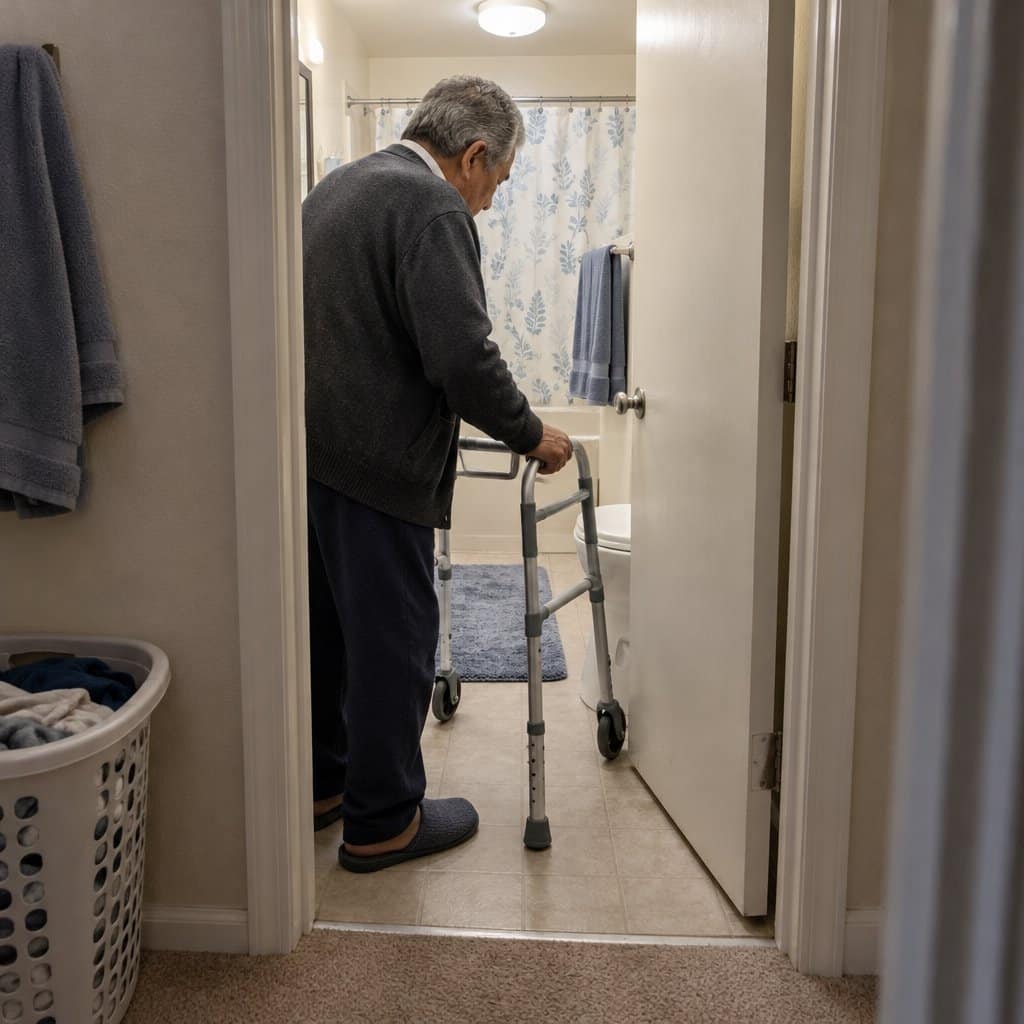
Safety in a Small Bathroom: Fitting Walkers and Equipment
Most of us do not get a large, ADA-compliant bathroom. A small one can still be made safer, and the first step is knowing what worries people most.
Say your mom comes home after hip surgery with a walker. She wonders whether it will fit in the room, and the shower chair she owned did not fit in the stall. Common concerns are fitting a walker or wheelchair, fitting equipment like shower chairs and alert systems, finding wall space for grab bars, clutter, and a door that swings open and eats up floor space.
A small room has some upsides too. You can steady yourself on the counter and walls as you move. There is less hard floor to fall on, and one non-slip mat can cover most of it. A small room also suits someone with limited stamina for walking.
If the door opens inward, consider taking it off. A sliding door or a curtain on a rod takes less room. Then you can turn the corner with a wheelchair or walker without hitting both the door and the toilet.
If you are coming home from a hospital or nursing facility, talk with your physical and occupational therapists about your bathroom layout. Training on a walker that will not fit in your bathroom does you no good. Practice moving along the counters and walls instead. If the walker fits but you cannot turn it around, practice walking backward with it.
If the walker will not fit, you need more than a doorknob or towel rack to hold. Hire a professional to install grab bars inside the shower, inside the tub, and on the walls. Good lighting matters in a small room too.
A small bathroom leaves less room for someone to help you. Be sure you can manage every transfer on your own with the right equipment in place: to the shower, the toilet, the wheelchair, and the doorway. If you cannot, look at other options, such as a bedside commode or a rented portable shower set up outside the bathroom.
A few equipment ideas for tight spaces:
- A shower chair, if the stall is large enough.
- A tub transfer bench, which straddles the tub edge.
- A non-slip mat in the tub and a slip-resistant rug outside it.
- A raised toilet seat, which helps after knee or hip surgery and often comes with armrests.
The floor matters in any size of room, so see this guide to non-slip bathroom flooring.
One trade-off: a bench can bump into the toilet or counter, so measure your space before you buy.
Sink Height, Personal Care Tools and Storage: Room-by-Room Measurements
When a product or bathroom is called “ADA-compliant,” that means it follows the Americans with Disabilities Act of 1990. These measurements give you a target to check your own bathroom against.
For the sink or vanity, the countertop should be no more than 34 inches high. The faucet should sit within a 48-inch reach. Keep the sink area free of clutter, with no plug-ins or wires near running water.
For the toilet, an ADA-compliant height is 17 to 19 inches. If the seat is too low, a person can get stuck on it, or try to stand and fall to the floor. My article on tall toilets for seniors goes into that, and my toilet safety guide covers the rest. Nobody should have to use a towel rack or toilet paper holder to push up from the toilet.
Many sinks sit in older homes, apartments or mobile homes where those measurements are not possible. The next best thing is adapting what you have. A removable or elongated faucet head helps with reach, along with an accessible soap dispenser and adapters for outlets that are hard to reach or unsafe.
For personal care, these tools help when physical or thinking abilities are limited:
- Wide-handled or manual toothbrushes and electric toothbrushes
- Toothpaste dispensers
- Razors designed to be easy on the hand
- Button hooks, dressing sticks and reacher grabbers
- Handheld flexible mirrors
- Long-handled holders for nail clippers, razors and hair brushes
Some people do these tasks outside the bathroom if space is tight, and that is fine. Medication routines belong here too, and my guide on medication management can help you keep them organized.
For storage, keep only the essentials in the bathroom and put the rest elsewhere. Store personal care items away unless you are using them. If you lack cabinet space and have wall space, put shelving at a height you can reach. A clutter-free room and floor prevent falls, spills and fires.
Next to the tub or shower, the same room-by-room thinking applies. Put grab bars inside and outside, and non-slip mats in both places too. Choose a shower chair by your needs and weight capacity. A bench suits limited mobility if you still have decent core strength, and this comparison of a shower chair and a transfer bench explains the difference.
One trade-off: if your sink was built before these measurements existed, adapting it will not match the standard exactly. Adaptive tools get you closer, though.
Helping a Loved One Bathe While Keeping Their Independence
If you help someone bathe, set up the room before they step in. Put a shower chair in place and grab bars on the wall, and put non-slip decals or mats in the tub and on the floor.
Always test the water temperature yourself to prevent burns. Then stay nearby in case they need a hand, because that is the best way to lower the risk of a fall. My guide on why some older adults stop bathing may help you understand what is going on.
Let them do the tasks they can manage safely. Offer a word of guidance, and step in only if they ask for help or clearly need it. That keeps their dignity intact.
If your loved one has dementia, post clear instructions or reminders for the showering steps. Labels or pictures placed near the faucet can help them understand what to do.
Keep track of their medications too. Some can cause dizziness, tiredness or confusion, which affects balance and mobility. Watch for changes in their physical or mental state, and talk to a doctor or pharmacist if you have concerns.
Talk with them openly about what worries them in the bathroom, and listen to their preferences. Their needs change over time, so check now and then whether what you set up still works.
One trade-off: staying nearby means giving up some privacy. Agree together on how close you will be, so the help feels respectful.
When to Hire a Professional, and Where to Find Help Paying
Plenty of bathroom changes are easy to do yourself. A mat, a handheld shower head or a shower chair needs no special skill.
Bigger jobs are different. If you are planning a larger remodel, consider hiring a contractor or an occupational therapist who specializes in accessibility. Their know-how helps you choose changes that fit your needs and keep the bathroom safe and workable.
Before you start any changes, walk through the room and look for slippery floors, poor lighting and things that are hard to reach. Make a list of what needs fixing. If you want a plan for the whole house, my 30 day safer home challenge is a good place to begin.
If you are helping someone bathe, stay nearby. Have a shower chair and grab bars in place, and test the water temperature first.
Equipment and remodeling can add up, so it helps to know where to look for help:
- Government programs: the HUD Title I Home Improvement Loan Program provides loans for home improvements, including bathroom safety changes. Medicare and Medicaid may cover certain shower safety equipment under certain circumstances.
- Nonprofits: Rebuilding Together offers free home repairs and modifications for eligible low-income homeowners, including seniors.
- Local help: your Area Agency on Aging or senior center can tell you about grants, low-cost loans and state programs near you.
- Taxes: the IRS has no specific deduction for shower safety equipment. Some expenses may count as medical deductions if they are necessary for your health and safety. IRS Publication 502 lists them, and a tax professional can tell you whether you qualify.
One trade-off: these programs have eligibility rules and coverage depends on your situation, so ask before you buy.
What to Do After a Fall in the Bathroom
Even with the right products in place, a fall can still happen. Having a plan ahead of time means you or your loved one will know what to do.
First, stay calm. Check yourself for injuries and take a moment to size up the situation.
If you are injured or feel too weak to move, call for help. Don’t try to tough it out.
If you are alone, call 911. If you are at home with family or a roommate, call out to them to come to your aid.
Then see your doctor as soon as you can, even if you don’t think you are hurt. If you suspect any injury at all, go to the emergency room.
If you are helping a parent or spouse, sit down with them and go over these steps before they are needed. Help them make an emergency plan so they know how to respond if a fall happens in the bathroom.
One trade-off: a plan only works if the person remembers it and can call out or reach someone. Go over it together now and then.
Lighting for Night Trips to the Bathroom
Middle-of-the-night bathroom trips are riskier than daytime ones for three reasons. You may be groggy from just waking up, the light is low, and your balance can be less reliable for the first few minutes.
Most people flip on the overhead light. That bright ceiling light can leave your vision struggling to adjust, and it jolts you fully awake at the worst moment.
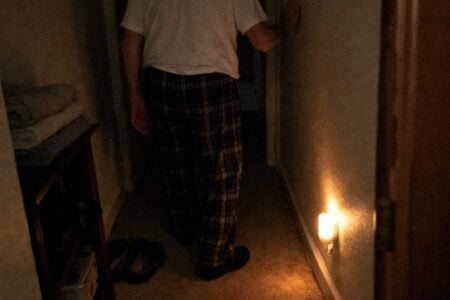
A better choice is a motion-sensor plug-in nightlight placed at baseboard level. Foot-level light shows you the path without blinding you or waking you up completely.
Two spots matter most: near the bathroom door, and near the toilet. Look for a model with reliable motion detection, so it comes on when you step into the room.
The same thinking applies to the route from bed to bathroom. My guide on bedroom changes that prevent nighttime falls covers that part of the trip.
One trade-off: a nightlight only lights the floor near it. It will not show you a step edge or a wet spot farther away, so it works best alongside the other fixes in this guide.
My 10 Must-Have Elderly Bathroom Safety Products
Here are my top recommended bath safety products. These are products I looked at closely and would consider for my own family.
Annnd Bottom Buddy Wiping Aid
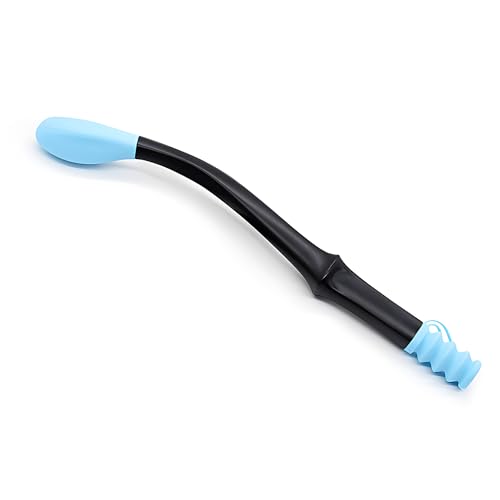

While we are on the toilet (so to speak!), wiping might be another place where you need help. It is also a topic most people would rather not bring up.
The ANNND Bottom Buddy Wiping Aid is a 15.6-inch wand made for exactly this. It holds a piece of tissue at one end, and a one-press release lets go of it when you are done. You never have to touch the used tissue.
The release works with one hand and does not take much grip strength. That can matter if you have arthritis or are recovering from a stroke. The angled head also means you do not have to twist or bend forward to reach.
It is made of non-porous ABS plastic and silicone, so it rinses clean at the sink in seconds.
Now the downsides. At 15.6 inches, it will not fit on a standard medicine cabinet shelf, so plan where it will live.
Loading the tissue takes a specific two-edge tuck, and that is not obvious until someone shows you. Expect a few tries before it feels natural.
Toilet Aid Wiping Tool


This is a long-handled wiping aid for people who can’t reach well enough to manage on their own. That might be after surgery, or with limited mobility. The point is to let you finish in the bathroom without asking anyone for help.
A silicone clamp on the end holds toilet paper or wipes firmly through the whole motion. When you are done, the release drops the used paper straight into the bowl, so your hands stay clean. It comes with spare silicone tops, so you can swap them out and wash them.
The trade-off is storage. The handle is a fixed 16.5 inches and does not fold or collapse, so it needs a spot of its own near the toilet. It is also plain and purely functional, nothing fancy to look at. If you want something you can tuck in a drawer or a travel bag, this is not it.
Drive Medical Premium Shower Chair
Shower chairs come in a lot of styles. I recommend one with a back and arms, because the extra support makes sitting down and standing up in a wet tub feel steadier. This Drive Medical Premium Shower Chair fits that description.
- It has a contoured backrest and padded armrests for support and comfort.
- Rubber feet help it grip the floor, and drainage holes keep water from pooling on the seat.
- The height adjusts without tools, in 1-inch steps.
- The arms and backrest are removable.
- It is made of aluminum and weighs 10 pounds, so it is easy to move between the tub and storage.
- Assembly needs no tools, and it supports 350 pounds.
One thing to know: removable arms and back are handy, but you need to make sure they are locked in place before you sit down. And if you need a seat that is much wider or has a built-in commode, a different style will suit you better.
Want to learn more about shower chairs? Click here to read my guide to the best shower chairs.
Medline Bathtub Safety Grab Bar

Easy to install
Easy to clean
Easy to use
Can you stand for a shower but getting over the tub edge is difficult or unsafe? The Medline Bathtub Grab Bar can help with this problem.
I love that it locks securely to the tub edge without damaging the tub. No permanent installation is required! And, you get a secure handle to hold onto while entering and exiting the tub without having to drill into your walls.
Why I recommend this model specifically:
- Easy to install! Simply clamp the bar onto your tub edge. It uses rubber-lined pads so that it doesn’t damage the tub surface. Just check it every now and then to ensure it is still tight.
- Easy to clean! It is made of PVC-coated steel. So, it won’t rust and just needs an occasional wipe down.
- Easy to use! Just hold onto the 6″ handle as you step in and out of the tub. This helps you balance yourself and makes you more stable.
A product like this is best if you just need some help getting over the tub edge. If you have difficulty standing for a shower, this won’t be as helpful
Carousel Sliding Shower Chair

A sliding bath and shower chair truly offer you the most secure and safe way to enter the tub and shower.
Transfer benches allow you to remain seated during the entire bathing process, from getting in the tub to getting out. No need for scooting, shifting, or standing. This device does all the work for you.
Here’s why a sliding transfer bench is better than a standard shower chair:
- Vision problems? The brightly colored seat is easier to see than a white shower seat.
- The padded seat, back, and arms lower the risk of skin tears and breakdown.
- Pivoting armrests make transfers easier because the arms move out of the way.
- Because the seat slides, you won’t have to scoot across the seat. Scooting can cause skin tears, especially if your skin is thin and fragile. A sliding seat nearly eliminates that risk.
- The swiveling seat is easier to get on and off of. That way, you can find the safest and easiest place to get on the bench.
- A seatbelt is included! Tool-free assembly for easy installation. Breaks down for travel too!
The Carousel Sliding Bath and Shower Chair is a premium product and may not be within everyone’s budget. But you should still consider it for anyone needing help getting out of the shower, especially if they are at risk for skin problems.
Read my guide to the best tub transfer benches here to learn more.
Gorilla Grip Bath Tub Shower Mat

A bath mat is an inexpensive but important safety tool. Many slips and falls happen in showers because a bath mat is not used.
A simple non-slip bathtub mat can make a huge difference in your bathroom safety.
Here is why I recommend this one:
- The top surface is textured and allows you to move while reducing your fall risk.
- The entire undersurface is covered with suction cups to stay safely in place.
- It’s larger than most. The 16″ X 38″ size gives you more room to move without worrying about your feet leaving the mat.
- This mat is anti-bacterial and resists the growth of mold and mildew, and it looks cleaner longer.
- It’s machine washable and easy to keep clean.
This mat has every feature I look for in bathroom safety. While it may not be as “stylish” as some other non-slip bathtub mats, it is clear and won’t clash with any other bathroom decor. But it is safe and functional!
Check out more bath mat options by clicking here.
Safe-er-Grip Suction Cup Grab Bars

Suction cup grab bars are an option if you do not want to drill holes in your shower. They install easily on any flat, firm surface without damaging it. This matters if you have a tiled or fiberglass shower. They help you steady yourself, but they should not be trusted to hold your full weight in a fall.
You might have doubts about their safety, though. They can help you steady yourself if installed exactly as directed, but they can lose their grip. Test the bar before each use, and do not count on one to hold your full weight.
However, not all suction cup grab bars are the same. This model from Vive is highly rated for user satisfaction.
For safe use, these must be installed on SECURE, flat, non-porous surfaces like ceramic tile (not on grout lines), glass (not on the shower door), and fiberglass and acrylic tub surrounds. As always, please follow the manufacturer’s instructions for installation. For the best suction, always make sure the surface is clean and dry before installing any suction grab bar.
Other important features:
- Color indicator tells you if the grab bar is stuck to the wall properly. It is a simple system: green is good, red means it is not secure.
- Easily re-positioned for portability or use in multiple areas of the shower if your condition changes
- Sturdy and rated for 300 lbs., though you should still not lean your full weight on a suction bar.
- Comfortable grip with soft rubber handles two sizes to choose from 12″ and 16″
AquaSense Handheld Shower Head
Another important product to consider is your shower head.
Let’s think through how you would shower from a seated position. First, reaching up to the showerhead is impossible without stretching.
Second, you are constantly hit in the face, or the water misses you completely. So, you try to reach or stretch to adjust the water flow, risking a fall.
A handheld shower head with a long hose easily solves this problem.
And here’s a good one:
- Extra-long hose. The seven-foot-long hose is durable and long-lasting. It is also tangle-free to reduce the chance of you tripping!
- 3 Spray Settings. You can have a standard, narrow, or wide spray by turning the dial. This saves water and reduces spraying outside the tub area. Wet floors = higher risk of falling.
- On/Off Switch is located at the handle base, so you don’t have to stand to turn it on or off.
Not all of them are easy to use, though. You want one with a long but tangle-free hose and simple controls on the handle.
See more of my recommended shower heads in this guide.
Drive Medical Bellavita Electric Bath Lift

Do you prefer a bath over a shower? Or do you miss an occasional hot soak? A bath lift might bring it back.
A bath lift lowers you into the tub by power and raises you back up to the tub edge when you finish. You run it with a push-button control, so there is no need to lower yourself down or pull yourself up.
The Drive Medical Bellavita Dive Reclining Electric Bath Lift Chair is one example. Here is what it offers:
- Low immersion: it lowers you to just 2.6 inches from the tub bottom, so you can get a full bath.
- Reclining backrest: it reclines 50 degrees, or a caregiver can remove it.
- Stable support: a dual column construction holds up to 310 pounds while rising, lowering and transferring. Suction feet grip the tub floor.
- Open seat design: a cutout at the front makes washing and personal hygiene easier to reach.
- Floating hand control: large, color-coded buttons, and the control floats in the water so it stays within reach.
- Adjustable height: the seat goes from 2.6 to 18.9 inches to suit most tubs. It measures 27.6″ wide by 40.2″ long.
Now the downsides. It is a sizable piece of equipment, so measure your tub first. It is also not for anyone over the 310 pound limit.
If you love a hot soak for tight muscles and achy joints, a lift like this can make that safe again.
Medline Toilet Handle Safety Rail
Easy to install
Adjustable handle heights
Easy to clean
Almost universal
Toilet safety rails are a good choice if you just need some help getting up and down. They add arms to your toilet set-up. Then, you can use those arms to push up or steady yourself on the way down.
Why these Medline Toilet Safety Rails stand out:
- Easy to install: just remove your existing toilet seat and bolt the frame through those holes. Then, mount your toilet seat onto the frame attachment. It’s easy enough that installation can be temporary if you want to remove them later.
- Adjustable handle heights: this helps get the best fit for you and your toilet. They even telescope in and out and fit better if you are thin or a little wider.
- Easy to clean: the rails are aluminum and just need an occasional wipe-down for cleaning.
- Almost universal: These rails work well with elongated and round toilet bowls.
Always follow the manufacturer’s installation directions for safe use. Not properly installing products like these on your toilet could lead to a fall or injury.
See more toilet safety rail options in this guide.
Xykeey Toothpaste Squeezer Rollers

This is a simple tool for the bathroom counter, and it helps most if you have arthritic hands and squeezing the toothpaste tube is difficult.
The XYKEEY set comes with 2 stainless steel rollers. You slide the end of the tube into the roller and turn the handle, and the paste comes out without a hard pinch or squeeze.
The handle turns clockwise or counterclockwise, so it works with either hand. It also rolls the tube flat as it goes, which gets out nearly all the paste and leaves little behind.
It isn’t only for toothpaste. It fits plastic and metal tubes up to 2.5 inches wide, so it can handle ointments, hand creams, hair gel and the like. The stand also lets the tube sit upright on the counter.
The trade-off is that it’s one more thing on the counter, and you have to slide the tube in and move the roller along as it empties. If your hands struggle with any turning motion, a pump dispenser may suit you better.
Shower Chairs for Sitting Down While You Bathe
Grab bars and non-slip mats help, but standing on a wet floor with soap running down your legs is still the riskiest part of a bath. A shower chair lets you sit for the whole thing. That helps if you get dizzy, get tired standing, have balance trouble, or are recovering from surgery. It also helps if getting in and out of the tub is the hard part. Some chairs swivel, so you can sit down facing the wall and turn to face the water without lifting your legs over the edge.
Here is what to look for. Check the weight limit first, and make sure the seat is wide enough for you to sit comfortably. Rubber tips on the legs keep it from sliding, and the legs should adjust so your feet rest flat on the floor. Holes in the seat let water drain, and a backrest and armrests give you something to push up from. The downsides are that a chair takes up room in a small tub, and it won’t fit every tub shape. A swivel seat is also one more moving part to keep clean. Before you buy, measure the inside of your tub.
Vive Health Swivel Shower Chair

This is a shower chair with a seat that swivels 360 degrees, stopping at every 90 degrees. The idea is that you sit down facing out, then turn to face the water, instead of twisting your body while stepping over the tub edge.
It suits people who have trouble standing for long periods, have limited mobility, or struggle with balance. The contoured seat has drainage holes so water does not pool under you. Vive Health also backs it with a two year guarantee.
The trade-off: a swivel seat is one more moving part. If you feel unsteady when something moves under you, a fixed chair or a bench may feel more secure. It also takes up room in the tub, so measure before you buy.
Bedside Commode Chairs for Nighttime and Hard-to-Reach Bathrooms
Grab bars and shower seats help once you’re in the bathroom. But what if getting there is the hard part? A long hallway at 3 a.m., a bathroom down a flight of stairs, or a day when your legs just won’t cooperate can all be a real risk for a fall. A bedside commode is a sturdy chair with a toilet seat and a bucket underneath. You keep it close to the bed, so the trip is a few steps instead of a few rooms. Many of them can also be used over your regular toilet as a raised seat with arms to push up from, which is handy if standing up is the trouble.
Here is what to look for. Check the weight limit, and give yourself some room over it. Look for a wide, solid frame that doesn’t wobble when you sit down or stand up. Legs that adjust in height matter, because your knees should be about level with your hips. Armrests you can really lean on are a must. Think about the downsides too. The bucket has to be emptied and rinsed, and that’s a chore for you or whoever helps you. It also takes up floor space, so measure the spot beside your bed before you buy.
Homland Bedside Commode Chair

This one frame does three jobs. You can use it as a bedside commode, as a raised toilet seat over your regular toilet, or as a safety support frame with arms to push up from. It is rated for 350 pounds.
That makes it a good fit if you are not sure how much help you will need down the road, or if nighttime trips to the bathroom are the hard part. The dual-crossbar frame is built to add side-to-side steadiness when you stand up or sit down. The legs adjust in height without tools and lock in place, so you can set it to fit you.
The trade-off is the bucket. It holds 7.5 quarts and has to be emptied and cleaned on a regular basis, so it works best when someone can make that part of the daily routine. It is also worth measuring your toilet and your own seat height before you order, so you know it will fit the space.
Bidet Attachments for the Toilet
A bidet attachment is a thin spray nozzle that fits under your regular toilet seat and rinses you clean with water. You keep the toilet you have. If reaching, twisting, or wiping is hard on your shoulders, wrists, or balance, it means less of all three. If you have arthritis or a sore back, it can also mean fewer awkward moments in the bathroom, and that is a real safety gain.
Here is what I would look for. Pick one with a simple control you can turn without much grip, ideally a single knob with big, clear markings. Check that it fits your seat, because a few odd-shaped or very slim seats don’t work. Metal fittings and a braided hose tend to last longer than all-plastic parts. Decide whether you want one that plugs in. Plug-in models add warm water and extras, but they also add a cord near water and more parts that can break. The non-electric kind is simpler, but it uses cold water only. In a chilly bathroom, that takes some getting used to.
Luxe Bidet Neo 120 Bidet Attachment


The LUXE Bidet NEO 120 is a bidet attachment that installs under your existing toilet seat. It uses water to rinse, so there is less reaching and wiping. That can make personal hygiene easier for anyone who finds the twisting and stretching difficult.
It needs no electricity, which means no cord near water. I like that for caregivers too, since there is one less thing to worry about in the bathroom. It works with a single knob, so there is very little to learn. The hose is braided steel and the valve core is metal-ceramic, both built to outlast plastic parts. It also has adjustable water pressure and a self-cleaning nozzle.
The trade-off is that it uses cold water only. If cold water on bare skin would bother you or the person you are helping, LUXE’s higher-tier models are worth a look instead. It is also designed for standard two-piece toilets, so a one-piece toilet may not work with it.
What Other Bathroom Safety Products Do You Recommend?
If you are researching bathroom safety accessories for a loved one, I encourage you to sit down and have a talk with them about their needs.
Reassure them that tools like these will help them be independent longer. This may help them want to bathe if they can keep their privacy. Let them know that they should not feel ashamed when using these products.
Now tell me about yours. Do you have a product in your bathroom that you can’t live without? Let me know in the comments below!
Also, if you found this information helpful, please share it with your friends on social!



Thanks
The attaching rails for toilets do seem better than the commode over the toilet – which if you grab the far side can tip over.
Toilet safety rails are a much safer option than clamp on toilet risers for sure. They also attach right to the toilet so they are less likely to tip over. Thanks for reading my guide!
As this is perfect thank you! I never really thought about ageing and how that might need to change bathroom layouts before – but it’s funny what can change with age. This is fantastic though – it gives me a good basis for the new bathroom design, so thank you ever so much to the writer of this piece. Though I would like to ask a quick question about walk in baths/showers etc – if anyone would be able to help me out at all? Essentially as my husband has gotten older, his legs have been causing him more and more problems. And one of the things he’s becoming most worried about is the bathroom and his own independence. He doesn’t want to have to rely on others too much, and still wants to be able to bathe himself and such, so we were thinking a walk in bath could be an ideal solution in this case. Does anyone know of any good companies we can get one from? I believe my husband’s friend mentioned a company called Gainsborough (I think this is the company – I’m 90% sure it is anyway: https://www.gainsboroughbaths.com/ ) Does anyone know if they are good? Or does anyone have any recommendations at all for other vendors? Or indeed any other alternatives? We’re completely open at this point! Any tips would be much appreciated as we’re very much at sea here!
Hi Izzy! My recommendation for walk in tubs is that you have them installed by a local, experienced contractor. And this is for several reasons. First, you can meet face to face and get a sense of their professionalism and experience. Second, you have a physical location that you can visit if there are problems and your calls aren’t returned. Third, you can check out local references from people in your own community. be sure to get a list of references preferably with photos of the final work. And, check each reference too. I don’t know much about this particular company. Thanks for your comment! –Scott