
If you want the short list, these are my top stabilizing utensil picks for Parkinson’s hand tremors, and you’ll find the details on each one further down.


If you or someone you love has Parkinson’s, you know how hard a simple meal can get. Food ends up on the plate, the table, or the lap, and that is frustrating.
The best stabilizing utensils for Parkinson’s can make eating steadier.
This article covers six picks, why special eating utensils help with hand tremors, the kinds of options out there (weighted handles, wide grips, swivels), and which ones make good gifts. I also point out the downsides of each.
The Best Stabilizing Utensils for Parkinson’s
There are many different brands on the market for stabilizing utensils. When finding the set that will benefit you the most, you want to consider price, functionality, and practicality.
Here are the 6 best stabilizing utensils to consider today:

KMINA Adaptive Spoon for Arthritic Hands
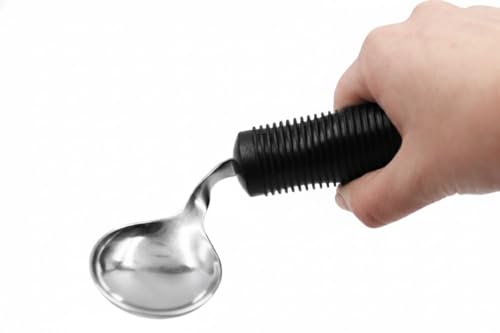
The KMINA Adaptive Spoon is made for people with Parkinson’s or arthritic hands. It does not use a motor. It works by giving you a grip that is easier to hold on to.
The handle is wide and soft, with a non-slip material so the spoon is less likely to slip out of your hand. It is listed as weighing 2.8 oz, which helps if your arm or wrist tires quickly.
If your hands are steady enough but your arm tires or strains when you lift food, I also wrote about the Meal Lifter eating device and how it eases that effort at the table.
The spoon also bends up to 90°, so you can set the angle that suits how you eat. It works for both right-handed and left-handed users.
One thing to know: this spoon helps you hold on and steer, but it does not cancel out a tremor. If your tremors are strong, you may still spill some, and a stabilizing or weighted utensil may suit you better.
It is also a spoon only, not a set. If you want a fork or knife to match, you will need to look elsewhere.
Weighted Utensils for Tremors
This is a four-piece set of weighted stainless steel utensils: a table knife, a fork, a tablespoon, and a deep bowl soup spoon. Each piece weighs a minimum of 7oz.
The extra weight is the point. For many people with Parkinson’s, a heavier utensil gives the hand something to push against, which can calm the shake and help food stay on the spoon or fork.
The handles are large with a wide, nonslip grip, so they are easier to hold on to. The set looks like regular silverware, just heavier, which matters if you would rather not draw attention to it at the table.
It also comes with a roll-up travel bag, so you can take it to restaurants or a friend’s house. A gift box is included too.
The trade-off is that 7oz per piece is a lot to lift. If your arm tires quickly or your shoulder is weak, a heavy fork may be harder at the end of a meal than at the start. Weighted utensils also don’t help every kind of tremor, so they are worth trying at a meal or two before you count on them.

BUNMO Adaptive Utensils for Tremors

Pros:
Cons:
This is a great bargain and it includes forks, knives, and spoons. They are made wider than other utensils and since they are weighted, it makes this stainless steel set of utensils ideal.
The wide handles are easy to grip, and the shape makes it simpler to cut foods like meat. They are shaped with Parkinson’s in mind.
Special Supplies Adaptive Utensils
This is a 4-piece set with a fork, a knife, a dinner spoon and a soup spoon. The handles are wider and weighted, which is meant to help with hand tremors, Parkinson’s or arthritis.
The handles are ribbed, with raised, textured grips and a food-grade silicone covering. That gives your fingers something firm to hold, so the utensil is less likely to slip as you bring it to your mouth.
The utensils are stainless steel and dishwasher safe. The set comes with black or gray handles.
One trade-off: weighted utensils feel heavier than ordinary silverware. If lifting your arm is tiring, the extra weight may not help. Wide handles also take a little getting used to, so give them a few meals before you decide.

Oneida Paul Revere Flatware Set

Pros:
Cons:
This stainless steel of utensils is great for everyday use and you’ll be glad that it never needs polished and still looks great. This is great for you because if there are any manufacturer problems, you’ll be able to have the pieces replaced.
You’ll love the way that you will be able to use these for harder types of dishes, like meats and larger meals. The handles fit comfortably in your fingers for an excellent grip.
Kinsman KEatlery Weighted Utensils
Pros:
Cons:
This set of four pieces each, which includes: knives, forks, and spoons is great to use for all different types of dishes.
You’ll want to time getting used to the utensils because the more that you practice with them, the less difficult eating will be. It is a little bit higher than the other utensil sets.

Why Do People with Parkinson’s Need Special Eating Utensils?
You know that with Parkinson’s, the tremors within the hands are devastating at times. Picking up small things is hard and eating is a chore in itself.
Preparing the meal is also difficult because the fingers tend to be weaker than other people who don’t have Parkinson’s.
With the best stabilizing utensils for Parkinson’s Disease, you’ll feel more confident when you are able to handle these types of issues.
What Utensil Options Are Available to People with Parkinson’s?
There are utensils that utilize weights, special handles, and swivels to assist someone with Parkinson’s.
This will allow you to mobilize the hand in a better way so that you can pick up the food quicker. In many cases, these utensils will prevent spillage too.

Quick Mention of the Stabilizing Utensils for Gifts
If you know someone who has Parkinson’s, these stabilizing utensils make an excellent gift idea. Not only for a holiday but birthdays and any other special occasion throughout the year. They can benefit from them in many ways.
When you have the best stabilizing utensils for Parkinson’s, you’ll be able to eat in a relaxed fashion. These are all excellent choices for you so that dealing with the disease will be much easier.
Do you have other devices or tricks for making eating easier for people with Parkinson’s disease? Please leave your comments and suggestions in the section below!